
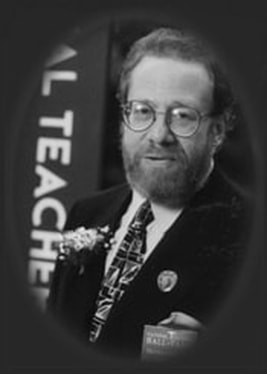
His Story
Thomas Porton earned his B.A. from New York University in 1969 and his M.A. there in 1971. He began teaching immediately after college, in 1969, at Jane Addams High School in the Bronx, an all-girls school at the time, teaching English. In that very first year he discovered an interest in coordinating student performances alongside his classroom teaching, which brought him the roles of Drama Coach and Senior Advisor before he had even finished his rookie year. In 1970 he was officially appointed to James Monroe High School as a teacher of English and Drama — an assignment that, in his words, became “the beginning of what has become a twenty-five year assignment,” and that he described as his home away from home for the rest of his career.
Through the 1970s Porton experimented with simulation games, team teaching, and open-classroom approaches, and volunteered to run film production and film study classes. One of those early students, Charles Lane, went on to Hollywood as a director for Walt Disney Pictures, winning recognition at the Cannes Film Festival while still in college. Porton’s most enduring project of the decade was the creation, through his Performing Arts class, of the Monroe Eagle Players — a traveling company of students who wrote and performed their own musical and dramatic productions at schools, community centers, public libraries, daycare centers, and senior citizens’ centers throughout New York City, and who performed with Pete Seeger at South Street Seaport for the National Bicentennial in 1975. Through the 1970s and 1980s he also worked with students to mount full productions of Broadway shows — “The Wiz,” “Grease,” “Sweet Charity,” “Fiddler on the Roof,” and “The Me Nobody Knows” — then took those productions on the road as touring companies to senior citizens’ centers across the city, watching elderly Jewish, Irish, and Italian residents embrace the Latino and African American teenagers who had just performed for them.
In the 1990s, Porton’s career took a new direction as he turned his students’ energy toward the HIV/AIDS crisis then devastating the Bronx. Working with his students, he built a set of AIDS-education projects: student-written pamphlets and brochures on preventing HIV infection and transmission; “friendship-grams,” through which hundreds of students wrote personal letters of support to people living with HIV and AIDS; “baskets of love,” gift packages of food and toiletries that students personally delivered to AIDS patients in local hospitals; and the AIDS VAN, his own personal mini-van converted into a mobile HIV/AIDS information center for street-corner outreach. In 1991 he formalized this work as the James Monroe High School/Project BRAVO HIV/AIDS Peer Educators, a collaboration with Project BRAVO, an AIDS outreach program of Montefiore Medical Center, that trained students to teach other teens across the city about prevention.
Porton’s honors accumulated across his career: the 1994 Teacher of Excellence Award from the New York State Council of English Teachers; the 1993/94 Mayor’s Volunteer Service Award, the highest volunteer honor in New York City, won by his student Peer Educators two years running; Teacher of the Year from the United Federation of Bronx Parents, three separate times; the 1993/94 Human Relations Award from the National Conference of Christians and Jews; recognition from the Caring Institute in Washington, D.C.; a proclamation from Bronx Borough President Fernando Ferrer naming a “James Monroe H.S./Project BRAVO Peer Educator Day”; and profiles of his AIDS-education work on WNBC, FOX, New York One, BRONXNET, in the New York Daily News, and in New York Newsday.
Beyond the Classroom
Across a quarter-century at James Monroe, Porton advised the Drama Club, the National Honor Society, the Senior Class, the Peer Tutoring Program, the Student Government, the Community Service League, and numerous other student organizations. As advisor to the Monroe Eagle Players since the early 1970s, he built a repertoire of touring productions with names of their own: an “Unforgettable Tour” of Nat “King” Cole songs to senior citizens’ centers, a “Broadway Tour” in which Porton himself played Tevye from “Fiddler on the Roof” for hospital patients, an “Over the Rainbow Tour” of Disney and children’s songs for daycare centers and homeless shelters, and “Ladies and Gentlemen of Soul,” a program built on African American music from Bessie Smith to Whitney Houston that began as a Black History Month project and was re-staged by new groups of students for years afterward. He produced annual multicultural shows blending music and skits for Christmas, Chanukah, Kwanzaa, and Three Kings Day, played Santa Claus each year for children at neighboring elementary schools, and created programs for Women’s History Month and Latin American cultural events. The Eagle Players received recognition from the American Theatre Wing, the National Actors Theatre, and the Governor’s “Decade of the Child” organization.
In his video and film production classes, Porton guided students to make original short films about the issues gravely concerning them. In 1988, a class he advised produced “Once Upon a Time…,” a video about crack addiction among young people that won a top prize from the New York State Drug Prevention Commission. In 1992, another group produced a “Stay in School” public service announcement that then-Mayor David Dinkins honored as the best in New York City. When asked by his principal to advise the school newspaper, Porton taught himself desktop publishing before teaching layout, editing, camera work, and interviewing to his Leadership Class students. He also initiated Dreams Become a Reality, the only student-run grant program of its kind in the country, funded by the Surdna Foundation, in which students themselves wrote and judged competitive grant proposals for how money should be spent for the good of their school and community. Former students of his went on to notable careers in the performing arts — among them Charles Lane (1973), an Academy Award winner who became a director for Walt Disney Pictures; Renee Brown (1975), who appeared on “What’s Happening” and “The Jeffersons”; Alexander Plummer (1976), who starred in the off-Broadway hit “Mama, I Want to Sing”; Stanley White (1984), an executive at Select Records; and Tiffany Wilson (1992), who signed a recording contract with a major label.
A month before his nomination went forward, Porton suffered a heart attack. Students, staff, and parents gathered to console one another and pray for his recovery, and calls poured in from teachers, parents, superintendents, and administrators across New York City. When his assistant principal visited him in the hospital, she brought a banner reading “Your Monroe family misses you,” signed by hundreds of people. Porton returned to school, curtailed his night-school classes on doctor’s orders, and in their place started new afternoon and weekend offerings in Video Production, Film Study, and Journalism — continuing, as ever, to take students to dinner and to Broadway and off-Broadway shows on his own time and at his own expense.
Philosophy Into Action
Porton described his approach to the classroom as project-oriented: he built each class around achieving a series of concrete projects, with student goals tied to completing them, rather than around lessons taught for their own sake. Students who read a short story might be asked to re-create it in a new genre — as a poem, a song, a play — then read and evaluate one another’s work, compile the best of it into a booklet, and finally perform it publicly for other students. He believed a teacher’s job was to show students the path, give them the tools, and then step aside, becoming an observer as the students carried the work to completion themselves.
That same conviction shaped how he thought about his role with students overall. He saw teaching as demanding more than subject knowledge — as requiring a teacher to be a positive role model and, particularly in an inner-city school where students carried real emotional burdens into class with them, to be ready to serve as a friend or a parent when needed. He also believed his most important teaching often happened outside the classroom altogether, in the community, at hospitals, at senior centers, and on street corners — a conviction that runs through nearly everything else he built at Monroe.
“I think that a teacher is a facilitator of knowledge. A teacher creates in the classroom an atmosphere in which the seeds of learning can take root and blossom… I am a firm believer that teaching involves putting aside one’s ego and gradually moving to the back of the classroom as the students take over the learning process and the teacher becomes an observer of that process.”— from his essay, “Philosophy of Teaching”
“I think that a teacher must be a positive role model for his/her students… Teaching brings responsibility for the welfare of a young person’s life. Aside from the parents themselves, there is no one in a young person’s life who has any more impact than a teacher. It is a trust that no teacher should ever betray.”— from his essay, “Philosophy of Teaching”
In His Own Words
“Why am I a teacher? I don’t have to ask myself that question because I don’t have any doubts that I am in the right profession. For over twenty-five years, I have loved my job. I love being with young people.”— from his essay, “Philosophy of Teaching”
“I entered teaching because I felt an inner need to make a difference in the lives of young people. Looking back on the past twenty-five years, I think I have more than achieved that goal.”— from his essay, “Professional Biography”
“Show the class the path, give them the tools, move aside, and let them work toward achieving that final goal. This is the format for what I consider to be the successful classroom.”— from his essay, “In the Classroom”
“I feel that much of my most important teaching has taken place outside the classroom and in the community. A classroom is not the only place for learning to occur!”— from his essay, “Outside the Classroom”
“As we approach the 21st century, the fate of American education is, to say the least, in serious jeopardy… the coming of the new century brings the challenge of extensive educational revisions which, if not implemented soon, will see the further, tragic decline of American education.”— from his essay, “Educational Issues”
What Others Said
“Porton was incredibly adept at balancing his role as authority figure and sympathetic counselor. He was able to be firm without being harsh, encouraging without being paternalistic. He commanded the respect and appreciation of all the students regardless of age, gender, race, class, sexual orientation, or learning style. Porton’s class was a microcosm of society with one exception: everyone belonged.”— Sofia Quintero, Chief of Staff, Council Member Lucy Cruz, and former student
“Thomas Porton is the quintessential educator… In retrospect, Mr. Porton is the ultimate educator who has influenced, and continues to influence, the lives of countless youngsters in a positive direction. He has earned the respect of his supervisors and peers.”
— Roberta J. Goldman, Principal, James Monroe High School
“It has been my very good fortune to be Tom Porton’s immediate supervisor for the past ten years. Never have I seen a more creative, committed professional… Mr. Porton not only deserves to be inducted into the Teachers Hall of Fame, he should have a hall of fame named for him alone. No pedagogue I have ever met in my thirty-year career in public education comes close to Tom Porton.”— Dr. Carol Gladstone, Assistant Principal, English Department
“I have worked with Mr. Thomas Porton for the past four years in a collaborative program which has trained James Monroe High School students to become HIV/AIDS Peer Educators… As a parent, I would hope that my own children would have the privilege of experiencing a teacher like Tom Porton.”— Elizabeth Ruffin, AIDS Outreach Specialist, Montefiore Medical Center
“He expanded my world and gave me the courage to explore it… He could have easily succeeded as an artist himself, (he would have made wonderful films) but chose, and continues to choose, to be an educator. He believes in the power of creativity when it is coupled with kindness and gives ceaselessly to his students.”— David Rafael Gonzalez, D.A., former student