
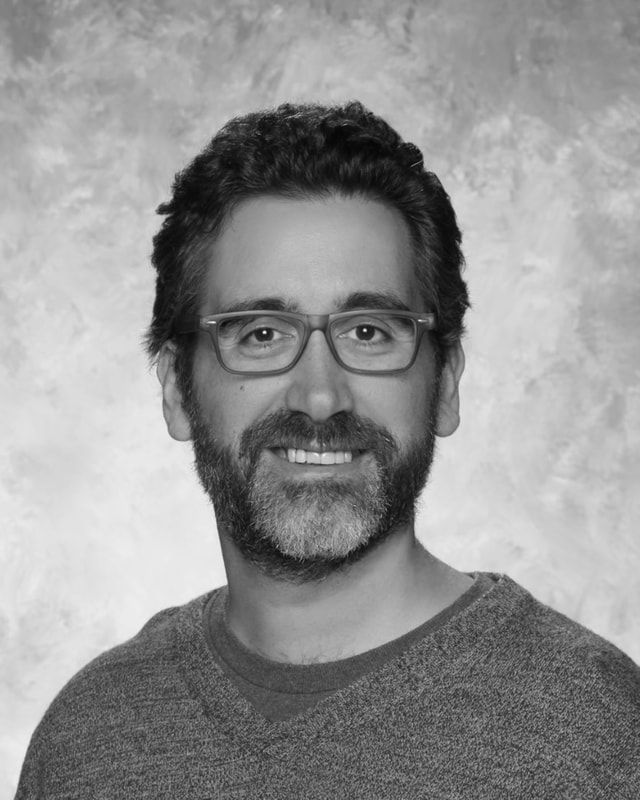
His Story
Bob Fenster planned to become a historian, but volunteering as a Big Brother and a Little League coach showed him how much he valued helping young people grow. He realized that he would never see the same kind of moment as a college professor, and perhaps he could find more of them by working with adolescents. He earned a bachelor’s degree in history and political science from Rutgers College in 1991 and a master’s degree in social studies education from Rutgers in 1993, and he has taught at Hillsborough High School since 1993.
Early on he knew that the best lessons are ones in which students take ownership, so he built simulations such as an advisers’ debate over dropping the atomic bomb. His rule was that if he cannot explain why a topic matters today, he probably should not be teaching it. Over the years he developed “labs” in his classes, loosely based on Nancy Sulla’s Learner-Active, Technology-Infused Classroom model, in which students get a set of learning goals and choose how to meet them. On a lab day, a visitor might see one group making a chart of the causes of the Revolutionary War, others listening to a podcast about the Declaration of Independence, a team designing a game about the Articles of Confederation, and three students conferencing with him about thesis writing.
His colleagues describe his assignments as including Twine interactive stories, rap battles, collages, game design, social media profiles for historic figures and podcasts. He holds lectures to about one a week, and students often ask for more of them. His classroom has a U-shaped seating arrangement for discussion, and he and a department partner, Rob Longo, have traded ideas for nearly fifteen years.
Beyond the Classroom
Fenster has advised Mock Trial, Model United Nations, Model Congress, Amnesty International and a podcasting club. In the 1990s he put together a concert at the school to give performers whose styles didn’t fit the choir or band a stage, and he has run about 50 shows since then, with rock bands, rappers, singer-songwriters, dancers, comedians and magicians. After Hurricane Katrina, a student asked about a benefit concert, which grew into Shelter From The Storm, a multi-platform event that raised $60,000 over five years for flood relief, veterans, homelessness, clean water in Haiti and Honduras, and education for girls in Pakistan.
He was the 2018 Reese Fellow at Crystal Bridges Museum of American Art, where he spent four weeks gathering interdisciplinary resources for social studies, English and art teachers, and he has held research fellowships at the Massachusetts Historical Society, Monticello, the Society of the Cincinnati and the Robert H. Jackson Center. A National Endowment for the Humanities program on Reconstruction at the University of South Carolina Beaufort inspired a visual essay project in which his students connect Reconstruction to modern issues, and the best ones have been published on the university’s website. He is also the author of the Fenster on Education blog, serves on the National Constitution Center’s teacher advisory panel and has served on his town’s recreation committee. His honors include the National Council for History Education’s Paul A. Gagnon Prize (2021), New Jersey Council for the Social Studies Teacher of the Year (2019), the American Lawyers Alliance Law-Related Education Teacher of the Year (2019) and a Claes Nobel Top Ten Educator of the Year award (2017).
Philosophy Into Practice
At the start of each year Fenster gathers data from standardized tests, past history and English courses and a student questionnaire to sort students into tiers for student growth objectives, adjusting the tiers during the year. Students evaluate their own essays before he grades them, and when several students struggle with the same skill, he runs ten-minute mini-lessons for small groups. A second-chance policy lets students revise to show mastery. His AP students have scored at least a point higher than the national average every year since the late 1990s.
He names teacher burnout and a lack of civility as major problems in education. For the second, he uses Socratic seminars and structured academic controversies in which students must argue positions they do not hold, on the theory that if they cannot argue both sides, they don’t truly understand the topic. He tells students that what matters is not their position, but that they use facts and listen to all perspectives before making up their minds.
“If I can’t explain why it’s important to the current day, I probably shouldn’t be teaching it.”Robert Fenster
In His Own Words
“I knew that the most effective lesson plans were ones in which students took ownership of the learning.”Robert Fenster
“It is through courteous dialogue that minds can be changed, and when we respect one another, we leave ourselves open to that possibility.”Robert Fenster
“If they cannot argue both sides, they don’t truly understand the topic.”Robert Fenster
What Others Said
“He is an innovator who is never satisfied with settling for good or decent, always looking to challenge himself and his students.”Robert Longo, nominator, colleague
“Mr. Fenster rises to the very short list of true, master teachers.”Karen A. Bingert, principal, Hillsborough High School
“No one compares in energy, creativity, and innovation.”Current colleague, Hillsborough High School
“Mr. Fenster is undoubtedly the high school teacher who most impacted my life.”Nina Jankowicz, former student