
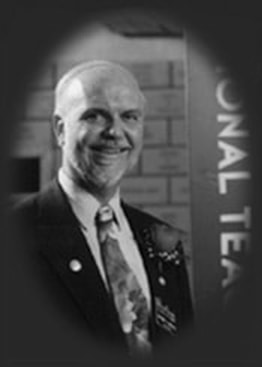
His Story
Robert W. Bruesch began teaching almost by accident, in a sense — in January 1966, he took the first teaching job he could find, a seventh-grade class at Fern School in Rosemead, California, mainly to satisfy his parents that he was finishing his credential while living on his own. He figured he would survive the multicultural, blue-collar neighborhood for five months and then move on to something else. Instead, he stayed thirty-one years and fell in love with the kids, their families, and the community. He taught a self-contained seventh-grade class for two years, then moved to sixth grade when the junior high departmentalized, believing his real strength was working individually with students rather than teaching 180 different faces a day.
In 1979, Bruesch left California for a year to teach at an Indian Day School on the Lower Brule Reservation in South Dakota, a decision he traced back to reading “The Trail of Tears” and wanting to do something for Native American students. There he built a Title I reading program with cross-age tutoring, an evening sports club, a parent committee, and a music program, and the effort was rewarded with increased funding the following year — the only program in the region to receive it. He returned to Fern School afterward, then moved to Emerson School in 1979-80 before settling at Willard School in 1980, where he remained through his nomination in 1996, still teaching sixth grade and bilingual education after sixteen years there.
Across three decades, Bruesch built an extraordinary record of classroom innovation: an after-school Science Club that sponsored the district’s first Science Fair; a film program whose student productions won the State Ecology Film Sweepstakes in 1973, beating out high school and college entries; annual Christmas Puppet Shows that doubled as writing and art lessons; K.I.D. P.O.W.E.R. (Kids Interested in Diligently Preserving Our World’s Environmental Resources), an outdoor education program that won the State Environmental Education Merit Award three times; and an original anti-gang, anti-graffiti musical, “The Shape of Things to Come,” written in response to the Los Angeles riots and performed for thousands of Rosemead students. In 1992 he was named his district’s Teacher of the Year and advanced to a state semi-finalist position; in 1994, the Milken Family Foundation named him a National Educator and awarded him $25,000, which he used to establish a community foundation rather than keep for himself.
Beyond the Classroom
Bruesch’s community involvement matched, and in some ways outpaced, his classroom achievements. In 1972, noticing that his school had almost no evening activities for local kids, he began driving “at-risk” boys to a Boys Club in a neighboring city; within a few years he was transporting sixty boys, three days a week, and in 1977 a group of parents helped him incorporate the Rosemead Boys and Girls Club — which ran out of his own garage until the school district provided a room in 1981. He served as its president for ten years, personally raised more than $5,000 annually to support it, and took nearly 500 boys and girls to summer camp in the High Sierras free of charge. In 1974, responding to a wave of new soccer interest among students recently arrived from Latin America, he founded the Fern School Soccer Club, which grew into the Rosemead Soccer Club and then an AYSO region of nearly 150 children, with a city championship played at the Forum.
In 1984, Bruesch took his community work “to the other side of the street,” winning a seat on the Rosemead City Council — on which he would serve thirteen years and be elected Mayor three separate times. From that position, he built out an entire civic infrastructure for at-risk youth: he revamped and expanded a remedial reading program through the Juvenile Diversion Project Board, obtained Community Block Grant funding for an anti-gang curriculum and counselor and for an Asian-Pacific Family Center counselor serving the district’s growing Asian population, and helped organize the Rosemead Youth Effectiveness System (Y.E.S.), a multi-agency board addressing at-risk youth through the Sheriff’s Department, Probation, Juvenile Traffic Court, and three school districts. As Mayor, he created the Mayor’s Fishing Derby, taking 200 at-risk youth fishing each year, and Youth Service Recognition Day, which has awarded more than 45 plaques to school and community youth groups for service projects. He also used his $25,000 Milken award to found R.O.S.Y. (Rosemead Organization in Support of Youth), which provides computers and printers to graduating eighth-graders and mini-grants to teachers starting youth service programs — and in 1978 adopted a “difficult to place” boy from a local school through California’s first Single Parent Adoption Program.
Philosophy Into Practice
Bruesch resists the idea of a tidy teaching “philosophy,” calling teaching instead something he simply does — and hopes to do well. But pressed to name his core beliefs, he points to three: teaching is a noble profession without punch-clock hours; everything a child encounters is a learning experience; and the ultimate purpose of teaching is to help students become responsible, independent-thinking adults. He believes teachers are naturally thrust into community leadership roles, whether the issue is reading, child nutrition, or gang violence, and that educators who wall themselves off from their surrounding community are failing their obligation to it.
He is equally direct about accountability and rigor: work in his classroom is due the day it’s due, with no excuses, and every member of a group project must do their share, because letting others carry the work breeds dependent adults rather than resourceful ones. He rejects both watered-down standards for struggling students and empty ceremony for its own sake — a school assembly, in his view, should be an extension of classroom learning, not a break from it.
“Teaching is a noble, respected profession, and as a profession, really has no hours or time limits. Teachers don’t punch time clocks, they just get the job done… Teachers are the sculptors of the shape of tomorrow and the citizens of that world.”— from his essay, “Philosophy of Teaching”
“Teachers carry the weight of the future in their plan books. With skills born by academia and honed by experience they have the ability to salvage a dream or create a hero. But first they must believe in themselves!”— from his essay, “Philosophy of Teaching”
In His Own Words
In January, 1966, I began teaching a 7th grade class at Fern School in Rosemead, California as a protest… I felt that I could survive teaching in this multicultural, blue collar neighborhood for five months, then I would move on to better things. I ‘survived’ for thirty-one years – and fell in love with the kids, their families and the community.”— from his essay, “Professional Biography”
“Ever since reading ‘The Trail of Tears’… I had a dream of ‘doing something’ for the Native American.”— from his essay, “Professional Biography”
“Welcome to room 15! Why don’t you stop for a while – but watch out! We may involve you in a special activity!… My class is a cauldron of learning experiences and a bevy of little witches and warlocks is continually stirring the soup.”— from his essay, “In the Classroom”
“‘Time watchers can’t be work watchers’ reads a sign below our class clock. The job is finished when the work is done.”— from his essay, “In the Classroom”
“I believe that one of the most glaring failures of most urban schools is the failure to make connections with their surrounding communities… What I have done, and what most schools should do, is let the students show the more positive, caring side of their personalities.”— from his essay, “Outside the Classroom”
What Others Said
“He is truly a teacher who believes, that teaching takes place at all times, and that learning takes place through participation and exploration. I am proud to work with Mr. Robert Bruesch, and I can’t think of a better representative of the teaching profession, to be honored in the Teacher’s Hall of Fame in Kansas, than Mr. Bruesch.”— Carmen Claissé, Principal, Frances E. Willard Elementary School
“Bob Bruesch realized that it was necessary to become involved at the City level to truly help the children in the City of Rosemead. He has successfully served 13 years as an elected City Councilman and served three times as Mayor. Mr. Bruesch certainly has been a true friend to old and young.”— Gonzalo & Jennie Flores, Parents
“Thirteen years ago I was asked to help refurbish an old former metal/wood shop at a local junior high school… A sign would be placed over its main entrance. It would read: ‘Boys and Girls Club of Rosemead.’… As the years went by, I wasn’t surprised to learn that a major inspiration behind the creation of our local club was Bob Bruesch.”— Chuck Hurley, President, Whittier Board of Trustees
“Mr. Bruesch was the recipient of the Milken Family Foundation National Educators Award… Instead of using the money for his personal interest, Mr. Bruesch took his money and started R.O.S.Y. (Rosemead Organization in Support of Youth).”— Carol Mahoney, Teacher, Muscatel Middle School
“Bob Bruesch has shown a unique involvement in educating students which put him at the top of the list as a memorable Hall of Fame Teacher. He used his inner city environment to send a strong anti-gang message while saluting the beauty of the arts in writing an anti-gang musical, ‘The Shape of Things to Come,’ and performing it to 3,000 Rosemead students.”— The Honorable Matthew G. Martinez, Member of Congress, 31st District, California