
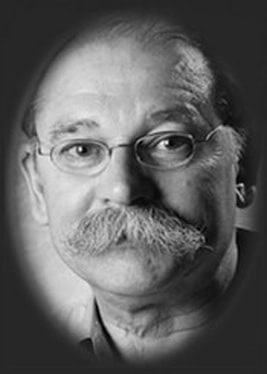
His Story
Randy Granger always loved art. At eight he began studying oil painting with an accomplished local landscape artist, and at ten he started a four-year apprenticeship with his father in sign writing and gold-leaf gilding, reaching journeyman status as a sign-writer. At fourteen he decided to become an art teacher. His high school art teacher at Point Pleasant Beach High School in New Jersey, Mr. Reichardt, showed him what a teacher could do. “I daily observed his positive influence on my peers… Mr. Reichardt modeled for me how I, too, could change lives.”
He studied art education at the Philadelphia Museum College of Art on a full-tuition scholarship that he kept by maintaining high honors, and at eighteen he committed to repay Pennsylvania’s generosity to a New Jersey student by teaching its children. After earning his BFA and teaching certificate, he served on active duty in the U.S. Naval Reserve during the Vietnam War, as a navigator, training officer and photographic officer on nuclear missile submarines. A mentor there, who knew nothing about art but everything about trusting others, taught him “that all things are possible.”
He joined William Penn Charter School, an independent Friends school in Philadelphia, in 1975 and has spent his career there, building the visual arts program into a center of the school. In 2000 he became Pennsylvania’s first National Board Certified Teacher in art. He was recently named Pennsylvania Art Educator of the Year, and he is the first independent school teacher to lead the state’s art educators as president of the Pennsylvania Art Education Association.
Beyond the Classroom
In 1998 Granger partnered with The University of the Arts to win a half-million-dollar grant for a technology-rich curriculum that used design to connect art and science, involving public and private schools, an art museum and a science museum. A second grant two years later extended it into a network of sites across Pennsylvania. Besides four National Endowment for the Arts grants, he has received support from the Pennsylvania Council on the Arts, and he teaches graduate courses in art education at The University of the Arts. The university’s Randy Granger Art Education Scholarship Fund honors his work, and a former student has endowed a chair in the arts at Penn Charter in his name.
His best-known project began in his freshman Design Science class, when he asked students to design a wheelchair that could be used in sand. The project outgrew the school calendar, so he and the students kept working on their own time with the Widener School for children with physical challenges and rehab engineers from DuPont Children’s Hospital. In October 2004 they received a permanent U.S. patent for the Dignified Broad Footprint Beach Wheelchair. The project was recognized as a national “Best Practices” example of design education applied to community service. His classes also solve assistive technology problems each year, including a pool wheelchair, a swimming vest for children with cerebral palsy and school bus step modifications.
For more than 23 years he has led student study trips abroad, including an Art Society trip to Paris in March 2003, so that students can deepen their cultural awareness. His Art Society students were founding members of a teen docent program with Philadelphia University, and he has mentored dozens of student teachers and hundreds of preservice art educators in Philadelphia. He earned a lifetime achievement recognition from The University of the Arts in 2001.
Philosophy Into Practice
At the core of Granger’s teaching is the belief that “all things are possible” and a commitment to “seek the artist in every person and draw it forth.” His model of art education balances “doing” with “thinking.” His classes follow a “spiral of learning” of perception, production, reflection and revision. He invites every parent by letter at least twice a trimester to join the class for critiques, and about 85 percent of parents attend at least two critiques per trimester. Students assess themselves at mid-trimester and at the end, rating a dozen areas of performance, and he scores the same criteria next to theirs. They are usually in close agreement.
He also offers voluntary exit interviews after grades are submitted, so students can rate his own performance. In his essay on educational issues he calls for more “forward-looking” learning, in which students use knowledge across disciplines to solve real-life problems, and for service learning in every high school.
“Success-centered classrooms are built from an atmosphere of trust, tested expectations, and respect. They are defined by a feeling of safe haven for all individuals to grow toward success.”— Randy Granger
“I feel that it is my primary responsibility to continually strive to seek the artist in every person and draw it forth. It is also my responsibility to seek to find the teacher in every student.”— Randy Granger
In His Own Words
“The only place where success comes before work is in a dictionary.”— Randy Granger, quoting Vidal Sassoon quoting one of his teachers
“Students in my classes feel okay about failure, because they know that, as their teacher, I value the potential for learning that comes from falling short of the mark.”— Randy Granger
“A key indicator by which I measure is the degree to which students demonstrate the ability to make their own beginnings.”— Randy Granger
“Hundreds of my past students have gone on to successful careers in the arts, communication, and education, and they continue to seek me out to discuss their work and share their achievements.”— Randy Granger
“I want every one of my students to find the arts to be within their reach, potentially joyful and expansive, and above all else, to be valued as important to one’s overall intellectual growth.”— Randy Granger
“I have followed my intentions through thirty-four years of dedicated service to students.”— Randy Granger
What Others Said
“I have spent almost 40 years in education and consider Randy Granger to be among the top five teacher/educators I have known.”— Earl J. Ball III, Head of School, William Penn Charter School
“Even at the William Penn Charter School, a place brimming with wonderful teachers, Mr. Randy Granger stands out.”— Mimi Peet, parent of a student
“I am convinced that Mr. Randy Granger is the most accomplished teacher I have ever met.”— Robert M. Burt, Ed.D., Principal, Abington Senior High School, and parent of two former students
“He is an extraordinary example of “our nation’s most important profession — teaching.””— Janis Norman, National Director of Education, Young Audiences, and Professor, The University of the Arts
“Randy is among the most exceptional colleagues I have had in twenty years of teaching art — perhaps the most exceptional.”— Sheila Ruen, art faculty colleague, William Penn Charter School
“Beyond class he taught honor, respect and self-respect.”— Bruce E. Segal, former student
“Mr. Granger continues to be a magnet drawing back alumni that otherwise would not have any further contact with the school.”— Caesar D. Williams Jr., Penn Charter overseer and alumni director
“Mr. Granger is unceasingly approachable and students can talk to him on any level, which leads to a lifelong appreciation and respect for him.”— Christy Woody and other students, Art Society