
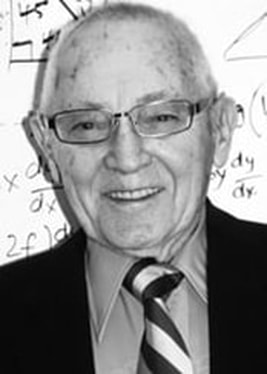
His Story
Paul Miller began teaching as an apprentice in December 1934, while still a student at the Maryland State Normal School, now Towson University, and has been teaching mathematics ever since. Over more than seven decades he has taught in about twenty-one school systems and colleges: Baltimore City and Baltimore County elementary and high schools, Johns Hopkins University for 42 years, the Community College of Baltimore (where he headed the mathematics department), Loyola University, Towson University, Coppin State and the University of Maryland. He now teaches algebra through calculus at Henry Beren High School, the Ner Israel school where he has taught for more than fifty years.
He holds a master’s degree in mathematics from Louisiana State University and studied on fellowships at Johns Hopkins, Michigan State and the University of Kansas. His principal calls him “a master teacher” whose students consistently post high SAT scores, and says he is “the exemplar for new teachers.” A former student recalls that Miller ran the room with a funny, spellbinding style and that “the room was silent and we really learned math.” Several families report that he has taught fathers and sons, and he continues to teach.
Miller’s philosophy is that “attitude not aptitude is what is most useful for learning.” He tells students up front what is expected, avoids surprises like testing material that was never taught, and treats success as the best motivator. He is proudest of helping an otherwise struggling student make real progress in a semester.
Beyond the Classroom
During World War II he volunteered evenings to teach soldiers at Fort Meade. In the 1950s and 1960s he tutored children who could not attend school in their homes at night, and in the 1970s he tutored minority teachers so they could become accredited in the Baltimore system. He also spent years teaching at the Jessup Correctional Institution to help prisoners find jobs after release, and he has taught underprivileged youth with some of his best students.
In the late 1940s and early 1950s he worked to change how geometry was taught in Baltimore, which led to curriculum changes and his book The New Euclidean, published around 1955. At the Community College of Baltimore he built the mathematics department and wrote Prerequisite Mathematics for College, and he taught finite mathematics to teachers seeking certification.
Philosophy Into Practice
Miller defines the best teacher-student relationship as one of mutual respect. “It is easy to be intimidating,” he writes, but that serves no purpose. Listening, patience and reassurance, especially for students who need more time, make a productive partnership.
He names two problems in education: over-reliance on technology, which can keep students from exercising their own minds (“If I ask a student today to do simple math, he or she is likely to pull out the calculator”), and students who have grown complacent and less passionate about learning.
“Math saved me in the war.”— Paul Miller’s answer when students asked why they had to learn math, as recalled by a former student
In His Own Words
“Attitude, not aptitude, is what is most useful for learning.”— Paul P. Miller
“As long as a student is willing to learn, I can teach him or her math.”— Paul P. Miller
“Success is the best motivator.”— Paul P. Miller
What Others Said
“Mr. Miller is a master teacher.”— Jacob Schuchman, Principal, Israel Henry Beren High School
“Teaching math is his life’s work.”— Meir Neuberger, President, Ner Israel Rabbinical College
“I never had a math teacher as good as Mr. Miller.”— Former student, Henry Beren High School
“He is a “Saint.”””— Former student
“Paul Miller is a most remarkable teacher.”