
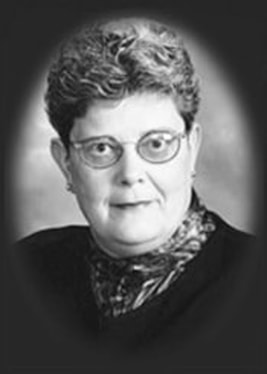
Her Story
Melanie Hocking says she did not choose teaching; it “captivated” her. She grew up in the Sputnik era, fell in love with science, and by twelve knew she wanted a scientific career. She prepared for chemical research at Marietta College, and during long, solitary hours in a graduate research laboratory at Ohio University, where “the only objects of my conversations were pieces of laboratory equipment,” she realized that teaching was the profession for her. She credits her eighth grade science teacher, Rachel Thomas, who made science “fun,” overcame gender bias in science and nurtured her curiosity.
She returned to Marietta College for her Ohio teaching certification, began teaching at her high school alma mater in 1975, and has been at Indian Creek ever since. She later earned a master’s degree in educational counseling from the University of Dayton. After seven years of work with the Indian Creek Education Association she studied law at night at Duquesne University and then earned a Master of Laws in oceans law and policy at the University of Virginia, combining her love of science with law. She now teaches chemistry and biology, including honors and Advanced Placement biology, and also serves as the district’s technology coordinator.
Her honors include a place on USA Today’s 2002 All-USA Teacher First Team, a Presidential Award for Excellence in Mathematics and Science Teaching (1998), National Board Certification (1999), and a Fulbright Memorial Fund Teacher Program trip to Japan (1997). She served on Governor Taft’s Teacher Advisory Board (2000–2002) and was a National Teachers Hall of Fame finalist in 2001, 2002 and 2003.
Beyond the Classroom
Hocking helped make Indian Creek a showcase district for technology, School-to-Work and Learn and Serve. She and her colleagues have written close to $1 million in grants, including a $200,000 Technology Literacy Challenge Fund grant that embeds multimedia technology in the curriculum.
Her best-known project is the Hillside Habitat. When an overgrown hillside beside the school needed work, her environmental science students mapped it, tested soil, raised nearly $1,000, and she wrote a $10,000 Milken Family Foundation Festival for Youth grant in 1998 to fund the reclamation. A kickoff celebration in the fall and a closing event in April 1999 brought students and the community together, with a health fair, a barbecue and a visit from NFL great Rosey Grier. The habitat grew into the Indian Creek Land Lab, where students, teachers and community members of all ages collect data and write beside the ponds.
Since 2001 she has led a three-member Indian Creek team at the Harvard Institutes for School Leadership. The team runs annual focus groups of students (grades 4 through 12, with third graders added), teachers, administrators and parents to find out what students value most, and uses the results to reshape the school’s culture. She is also a long-time negotiator and rights-and-responsibilities chair for the local education association, a Mensa member and a keynote speaker for Kappa Delta Pi.
Philosophy Into Practice
Hocking describes herself as a “Teacher of Young Individuals” rather than “Teacher of Students.” Her classes use the Baldrige approach to school improvement: each class writes a mission statement, lists the traits of a good student and a good teacher, charts its own progress with sticky notes and stickers, and writes “prescriptions for improvement.” A survey after the first trimester found that over 80% of her students felt the process helped them achieve more. She uses Einstein posters and Peanuts cartoons, analogies (electrons as bees swarming a hive), and “Far Side” cartoons, and she is known to students for her sense of humor and for telling stories about her well-educated dog, Chase.
“Teaching and learning involve individuals first, subject matter second.”— from her essay, “How Do You Measure Success?”
“Humor, never leave home without it.”— her motto, as quoted by a colleague
In Her Own Words
“I did not choose teaching as a profession; it captivated me.”— from her essay, “Professional Profile”
“I simply do what I love to do – to teach and interact with my students and colleagues.”— from her essay, “Professional Profile”
“Those who enter my classroom each day are young individuals first, my students second.”— from her essay, “Educational Issues”
““We” is the operative word in education today.”— from her essay, “Educational Issues”
“Be prepared, be organized and communicate clearly and effectively.”— her advice to students, from her essay, “How Do You Measure Success?”
What Others Said
“Students take her classes, all electives, to get her as a teacher.”— Jene Watkins, Superintendent, Indian Creek Local School District
“The most important quality is the professionalism that Ms. Hocking brings to the classroom.”— John Craig, Principal, Indian Creek High School
“Mel is one of the best teachers I have had the pleasure of working with in my twelve years as a high school educator.”— John L. Belt, science colleague, Indian Creek High School
“Her enthusiasm for sharing knowledge overflows to her students, fellow teachers, both elementary and secondary, and administrators as well as members of the community.”— an elementary teacher and longtime collaborator
“Ms. Hocking has a way of making every student strive to be better than they thought they could be.”— Brandon R. Lash, former student
“Ms. Mel is a short, dynamic, self-actualized lady that believed in me when no other teacher in that school would.”— Michael, former student, quoted by his mother, Donna L. Minor
“Not only is she a great teacher, she is a great person and will help anyone with any type of problem that she can.”— Aaron Saltsman, student