
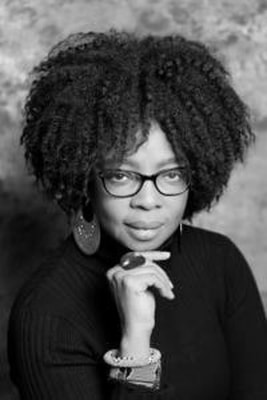
Her Story
Matinga Ragatz taught social studies and world language to high school students for 22 years, at Lansing Christian Schools and then Grand Ledge High School in Michigan, where she taught global studies. She began her career in international law but, in her words, found that once she entered a classroom she “needed to find my voice within this profession.” For 20 years she took students with her on her travels to ancient temples, East Asian street food alleys, North African markets, the Aegean Sea and the streets of Latin America.
She believes the purpose of teaching is “to discover talent and curate human abilities,” and that school should give students many chances to try on different versions of their future. In her classroom she moved from rows of desks to collaborative spaces that look like coffee shops or bookstores. Students learned from her content videos, worked at their own pace through a learning management system, and began each unit with a memorable opening event. A student who loved fashion, for example, could study how historic events changed what people wear.
She tried to avoid becoming the “answer portal” for every question. Her “Ask 3, then me” policy sent students to their peers and to experts outside the classroom first, so that they came back with better questions. She wants students to focus less on what they know than on what they can do with it.
Beyond the Classroom
Ragatz was the 2011 Michigan Teacher of the Year and a Microsoft Innovative Teacher in 2008. She is a co-founder of the Michigan chapter of the National Network of State Teachers of the Year, a board member of the Michigan Association of Computer Users in Learning, and a member of the Network of Michigan Educators’ executive committee. She is the author of the guidebook Practical Strategies for Flipping Learning in Your Classroom, published by the Bureau of Education and Research in several editions.
Her global studies students organized community ethnic festivals with artists and scholars from around the world, started a nonprofit to provide nutritious food to their peers in Africa, and raised funds for homeless peers. She is now helping start a food economy school in northern Tanzania, and Michigan students are working with its young scientists on crops, climate and soil, while a high school band composes background music for a Tanzanian children’s song.
Since 2012 she has worked in professional development, first for the Eaton Regional Education Service Agency and then as a learning consultant with Communications by Design. She has led more than 300 seminars and sessions, spoken on national and international stages, and hosted workshops in Europe, East Asia, Africa and Latin America. She also mentors teachers one on one as they redesign their lessons.
Philosophy Into Practice
Ragatz believes that “young people who take part in building a community are less likely to destroy it,” and that teaching becomes more purposeful when the community receives the work students produce. She designs her professional development around Simon Sinek’s Golden Circle, starting with the “why,” and around Maslow’s hierarchy of needs, so that teachers feel safe enough to hear disruptive ideas.
On assessment, she argues that rubrics and standardized tests are a poor measure of messy, internet-age learning. Her answer is to add more varied checkpoints, including self-assessment and peer feedback, so that students “could predict the results of their efforts” and feel less stress. She also believes that equality is not the same as equity, and she encourages teachers to use technology to “multiply themselves” so they can spend more time with students who need help, encouragement or a challenge.
“School becomes transactional when it loses the focus on being transformational.”Matinga Ragatz
In Her Own Words
“I believe teaching is a unique enterprise that requires practitioners to create learning environments that allow young people to practice and role play the many different dimensions of life.”Matinga Ragatz
“It is no longer a question of what students learn, but what they can do with what they learn.”Matinga Ragatz
“Teachers come to my sessions to hear disruptive learning ideas, and the positive, purposeful and productive experience encourages them to dream big and work to change the world!”Matinga Ragatz
What Others Said
“Matinga Ragatz is a stellar educator bringing the world to her students and her students to the world.”June Teisan, nominator, 2016 NTHF inductee
“Matinga’s leadership abilities are profound and complement the natural way that she builds a sense of mission and purpose with the teachers for whom she works.”Sara Easter, president, Communications by Design
“She has founded a school in Africa in an underserved area and works hard to provide for the teachers and students of that school.”Peter Grostic, Ed.S., director of professional learning, Communications by Design
“Inspirational. Authentic. Innovative.”Aubrie Marsh, sixth grade teacher, Jonesville Middle School
“It is because of my relationship with Matinga that I have developed into the teacher that I am today.”Jill Nicholson, teacher, Clinton Community Schools