
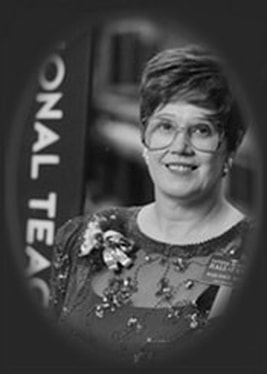
Her Story
Marjorie E. West earned her B.A. in Elementary Education from the University of Northern Colorado in 1962 and began a first-grade teaching career that would take her across the country and around the world: Colorado Springs, then Department of Defense schools in Wiesbaden, Germany, then Fort Wainwright, Alaska, then Great Bend, Kansas, and Killeen, Texas, before she joined Jefferson County, Colorado schools in 1969. In 1970 she settled into Glennon Heights Elementary School in Lakewood, where she would teach first grade for the next twenty-five years. She later returned to school herself, completing an M.A. in Reading from Northern Colorado in 1970 and, during a 1981-82 sabbatical, eighty additional semester hours in Special Education, Gifted and Talented, Learning Disabled, Physically Handicapped, and Emotionally Disturbed education at Louisiana State University and the University of New Orleans.
In August 1987, West was diagnosed with a degenerative vision disorder that took her sight. Rather than leave the classroom, she became the first legally blind teacher in Colorado permitted to continue teaching in a regular classroom, working alongside a guide dog and a full-time teaching aide — a precedent for handicapped awareness that drew coverage from NBC’s local and national news. She never left first grade, teaching by voice, memory, and the trust of her students, parents, and colleagues for the rest of her career.
Her honors piled up especially in her final years of teaching: 1994 Colorado Teacher of the Year, a finalist for National Teacher of the Year and for the National Teachers Hall of Fame that same year, the Freedom Foundation at Valley Forge Teaching Medal of Excellence, an appearance on CBS This Morning, a Goals 2000 Teacher Forum participant, and appointment to the Colorado State Accountability Committee. Earlier in her career she won the University of Northern Colorado’s Trailblazer Award as an Honored Alumna, was featured in Woman’s World magazine, received an honorary lifetime membership in the Colorado Parent-Teacher Association, and was selected for inclusion in Who’s Who of American Women, 2000 Notable American Women, and Who’s Who in American Education.
Beyond the Classroom
West was a leadership training teacher at Glennon Heights from 1982 to 1990, served on the school’s Gifted and Talented Steering Committee from 1982 to 1995, originated the school’s grant-writing team in 1989, and served on the Jefferson County District Curriculum Development Committee for Reading. She was active in Epsilon Sigma Alpha, Pi Lambda Theta, Phi Delta Kappa, the International Reading Association, and was a National Education Association delegate to the Delegate Assembly for nearly a decade. In 1994 she was nominated for National Teacher of the Year, which brought extensive travel as a spokesperson for public school teachers and public education, including attending the second annual Goals 2000 Teacher Forum in Washington, D.C., and by 1995 she was coordinating the first-ever Colorado State Teacher Forum, working to make teachers partners rather than objects of school reform.
Inside her own school community, West made her classroom an extension of family life. She held weekly “Lunch Bunch” support groups for students to work through problems together, monthly “Read and Feed” evenings that brought families in for reading and fellowship, and wrote a weekly class newsletter to keep parents informed and involved. She provided free childcare during evening PTA meetings and parenting classes so parents could attend, made home visits to every one of her students’ families, and welcomed senior citizens into her classroom weekly through the O.A.S.I.S. tutoring program.
Philosophy Into Action
West described her philosophy of teaching through the words of Kahlil Gibran — that a teacher “does not bid you to enter the house of his wisdom, but rather leads you to the threshold of your own mind” — and believed the important thing in teaching was the how, not the what: students had to be given the skills to learn how to learn. She blended whole-language techniques with direct phonics instruction, integrated thematic units, and cooperative learning, believing that school had to satisfy her students’ basic needs for survival, love, power, fun, and freedom before real learning could happen. Alongside the traditional “3 R’s,” she taught an additional three: Responsibility, Respect, and Restraint, using classroom meetings, peer mediation, and cooperative learning groups to build self-esteem and conflict-resolution skills.
After losing her sight in 1987, West turned what she called “what could have been a career-ending handicap” into a teaching tool itself, using her own disability to show her students that it is not circumstances but attitudes that make us happy — that a child should concentrate on abilities rather than disabilities. Former students remembered her showing up at their weekend soccer games, dark glasses and white cane on the sidelines, cheering them on by voice alone.
“I have been dealt what could have been a career-ending handicap and have turned it into an asset. In August, 1987, I became the first legally blind teacher in Colorado to teach in a regular classroom with the assistance of a dog guide and a full-time teacher aide. We ‘did it right and made it work.’ … I use my disability as a positive teaching tool, displaying that it is not circumstances but attitudes that make us happy.”— from her essay, “Inside the Classroom”
In Her Own Words
“I’d like to be remembered for the difference I make in shaping the lives of my students, for providing some of the light in the children’s eyes as they discover the ‘magic’ of reading, for the care and love we share together, for the encouragement to become autonomous, life-long learners and for helping to mold their dreams.”— from her essay, “Inside the Classroom”
“I possess a tremendous power to make a child’s life miserable or joyous. I can be a tool of torture or an instrument of inspiration. I can humiliate or humor, hurt or heal. In all situations, it is my response that decides whether a crisis will be escalated or deescalated and a child humanized or dehumanized.”— quoting Haim Ginott, in her essay “Philosophy of Teaching”
“Students must be given the skills to ‘learn how to learn.’ … No reward is greater than to see these students emerge as growing, living, changing, normal, healthful, productive beings who are conscious and proud of their own self-worth and identities.”— from her essay, “Philosophy of Teaching”
What Others Said
“Marge West, my son’s first grade teacher, broke the news gently… As Marge’s student, Jason learned that the ‘blind’ teacher had eyes in the back of her head… just like the sighted teachers… Her greatness lies, not in grand educational innovations, but in the daily giving of herself, despite a personal handicap that would paralyze most of us. Please consider Marge ‘above and beyond’ the others.”— Tim Hughes, Parent
“Although legally blind, Mrs. West, with the assistance of her guide dog, ‘Rush,’ is an extraordinary model who has an enormous positive impact at Glennon Heights Elementary School. Her unlimited energy, her high sense of values, her love and understanding of children, along with her extreme competence and dedication, have earned the gratitude and esteem of students, parents and colleagues.”— Larry Charles, Principal, Glennon Heights Elementary School
“There is, however, one thing that puts her over the top. Marge is legally blind and must be accompanied by a seeing eye dog. Her disability has in no way caused her to compromise her quality of teaching. In fact, she always goes that extra mile and works hard to maintain excellence in her classroom.”— Teresa A. Fink, Colleague, Glennon Heights Elementary School
“Marge has fought adversity in her own life while continuing to pursue her dreams. In 1987, she made history by becoming the first legally blind teacher in Colorado allowed to teach in a public education classroom with a guide dog and full-time teacher’s assistant.”— Wayne M. Carle, Superintendent, Jefferson County Public Schools
“Marge is a master teacher who is highly respected and valued not only in our school but throughout the district and state… The one statement I remember foremost that Marge said is: ‘I am not the best teacher. I am a representative of the many good teachers in the teaching profession.’ In my eyes, she exemplifies the ‘best’ of what a teacher should be.”— Nancy Willingham, Colleague and Nominator