
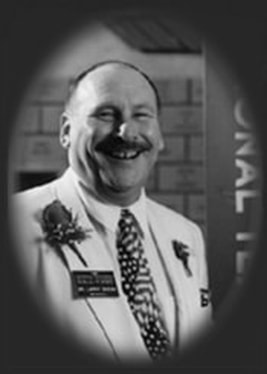
His Story
Lawrence Joseph Baran built his career on the belief that students with disabilities deserve the same chance to shine, contribute, and be seen as anyone else — and he proved it not with a typical special education curriculum, but with flowers. Since 1980, Baran taught special education at Homewood-Flossmoor Community High School, where he developed a vocational floral design program that trained students with disabilities to design and construct floral arrangements, corsages, and boutonnieres to professional standards. What began as a classroom skill-building exercise grew into something far larger: a program called “Americans with Disabilities in Action,” through which Baran’s students created flowers and floral tributes for an extraordinary run of national civic, patriotic, and historic occasions throughout the late 1980s and 1990s.
Over the years, Baran’s students’ floral work reached the highest levels of American public life. Their creations were part of events connected to the 1989 inauguration of President George H.W. Bush and Vice President Dan Quayle, and continued through ceremonies and observances involving Presidents Bush and Clinton, Vice Presidents Quayle and Gore, General Norman Schwarzkopf, General Colin Powell, Senator Bob Dole, Coretta Scott King, First Ladies Hillary Clinton and Barbara Bush, and Department of Veterans Affairs Secretaries Edward Derwinski and Jesse Brown. In 1996, the program’s reach extended internationally with a bubble-gum project tied to Bosnia, sending a piece of home — and a piece of his students’ work — to American troops deployed overseas. Each project doubled as both a civics lesson and a vocational training exercise, giving Baran’s students real deadlines, real craftsmanship standards, and real recognition from some of the most prominent figures in the country.
Baran’s own life added another dimension to his teaching. Diagnosed with cancer in March 1995, he became known to his students and colleagues by the nickname “Captain Rainbow” as he faced his illness with the same optimism and determination he brought to the classroom. His story as a teacher and a cancer survivor became the subject of a documentary, “Roses Around the Heart,” which chronicled both his classroom’s floral design work and his personal journey — a fitting title for a program that had always been about turning something small and beautiful into a source of dignity and pride for students the wider world too often overlooked.
Beyond the Classroom
The “Americans with Disabilities in Action” program was never confined to the school building. Baran organized his students’ floral work around the national calendar — inaugurations, memorial observances, veterans’ events, and visits from dignitaries — turning each into an occasion for his students to be seen not as special education students but as skilled contributors to significant national moments. The steady stream of thank-you letters and acknowledgments his classroom received from the White House, the Department of Veterans Affairs, and members of Congress became, in effect, proof to his students that their work mattered on the largest possible stage.
His illness and treatment beginning in 1995 did not slow this work; if anything, his students and colleagues describe him redoubling his commitment to the program even as he underwent cancer treatment, carrying the nickname “Captain Rainbow” as a badge of resilience rather than retreat. The 1996 Bosnia bubble-gum project, sending a piece of his classroom’s spirit to deployed American troops, is emblematic of how far Baran was willing to extend his students’ reach and sense of purpose beyond Homewood-Flossmoor’s walls.
Philosophy Into Practice
Philosophy Into Practice
Baran’s philosophy of education centered on dignity through purposeful work. He believed students with disabilities did not need to be shielded from ambitious, high-visibility projects — they needed to be given them, with the scaffolding and support to succeed. Vocational floral design was, in his hands, never merely occupational therapy; it was a rigorous craft that could stand up to national scrutiny, and he insisted his students hold themselves to that standard. He believed that when students with disabilities were given real responsibility and real recognition, their sense of self-worth and their skills grew together.
“My students are not just making flowers — they are making a statement to the entire country that Americans with disabilities can contribute at the highest level, if only given the chance.”— from his essay, “Philosophy of Teaching”
“Every boutonniere that leaves this classroom carries the pride and hard work of a student who has been told, too many times, what they cannot do. I want them to know exactly what they can do.”— from his essay, “Philosophy of Teaching”
In His Own Words
“When I was diagnosed with cancer in March of 1995, I made a decision that this illness would not define me, and it would not stop my students’ work. If anything, it renewed my sense of urgency to show them what perseverance looks like.”— from his essay, “Professional Biography”
“I have always believed that students with disabilities rise to the level of expectation placed on them. Give them a routine, undemanding task, and that is what you will get. Give them a national stage, and they will surprise you every time.”— from his essay, “In the Classroom”
“Our floral projects are never just about flowers. They are about teaching young people with disabilities that they belong in the biggest rooms in this country — because they do.”— from his essay, “Educational Issues”
“‘Captain Rainbow’ is not a name I chose for myself. My students gave it to me, and I have tried every day since to live up to it.”— from his essay, “Outside the Classroom”
What Others Said
“Larry Baran has done something I have never seen another teacher accomplish: he has made our special education students the pride of this entire school district, one boutonniere at a time.”— Colleague, Homewood-Flossmoor Community High School
“Watching Larry continue this program through his cancer treatment, never once letting his students see him waver, taught them more about courage than any lesson plan ever could.”— Letter of Recommendation
“The letters of thanks his classroom has received from the White House and from generals and senators are remarkable, but what is more remarkable is how ordinary Larry makes it seem to his students — as if of course their work belongs there.”— Letter of Recommendation
“He calls it a floral design class. I call it one of the most effective self-esteem interventions I have ever witnessed in twenty years in special education.”— Letter of Recommendation
“Larry Baran is ‘Captain Rainbow’ to his students because he has shown them, quite literally while fighting for his own life, what it means to keep bringing color into the world.”— Letter of Recommendation