
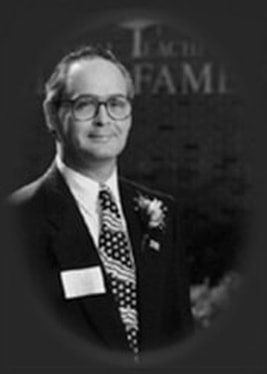
His Story
Gary Swalley earned his B.A. from Southern Illinois University at Edwardsville, followed by his secondary certification in 1976 and his elementary certification in 1985. His entire career was built in one district: after student teaching at the junior-high level in 1976, he spent seven years teaching 7th grade American History, then moved into 7th grade English and history, and in 1985 became Department Chair of Social Studies at Edwardsville Junior High School, a post he held for five years. By the time of his nomination he had returned to full-time 7th grade social studies teaching, the role in which he’d spent 19 years and which he described as the vehicle through which he reached out to the youth of his community.
In 1994-95, Swalley took a year’s sabbatical from Edwardsville Junior High to serve as a Teaching Fellow in the School of Education at Southern Illinois University Edwardsville, where he supervised student teachers in their field placements and taught the university’s Social Studies Methods course. Southern Illinois University had earlier called on him as a consultant to its Educational Leadership Program, and the district itself relied on him every year to help train and inspire its incoming teachers as part of its Teacher Orientation Project.
Over nineteen years in the classroom, Swalley’s honors accumulated at every level: a Fulbright Scholarship to China (1989), a Rotary Scholarship to Belgium, a Teachers Fellowship to Japan, the Freedom Foundation Award at Valley Forge, recognition as the district’s “Those Who Excel” Teacher of the Year (1991) and its Thanks to Teacher Award and Professional Best Award (both 1990), the Reader’s Digest “American Hero in Education” award (1992), selection as one of Maxwell House’s 50 REAL HEROES nationwide (1993), National Middle School Social Studies Teacher of the Year from the National Council for the Social Studies (1993), Illinois State History Teacher of the Year from the Daughters of the American Revolution (1994), a Danforth Leadership Fellowship — the only one awarded to an Illinois teacher that year — a national finalist recognition in Learning Magazine’s “Professional Best” competition, a Teacher Exchange to Germany (1995), the Kimmel Community Service Award in the youth category from the Belleville News-Democrat and SIUE (1995), and recognition as Outstanding Supervisor for his work training future teachers (1995).
Beyond the Classroom
Swalley’s best-known achievement was Project 2001: The Ultimate Field Trip, an independent research program in which junior high students explored the challenges and opportunities of life in the 21st century, researching environmental issues, attending classes at Epcot, Sea World, and the Kennedy Space Center, and arranging for astronaut Tom Akers to speak to the school as part of the program. Students then shared their findings back home through workshops and a traveling Environmental Fair at every third-grade center in the district, and raised the money to fund it all themselves — over $130,000 across seven years, including $32,000 in a single three-month stretch — through partnerships with two local banks, two major local companies, and the Optimist and Rotary clubs. In 1992, the program and its students won $15,000 from Reader’s Digest and were named one of the 20 top school-business partnerships in the nation by Apple Computers.
Swalley also organized the district’s ACT I Drama Club, whose 7th and 8th graders performed original plays confronting substance abuse — one set in a juvenile detention home, another titled “Say Yes to Life” — before more than 5,000 students in Edwardsville and neighboring districts, including the Illinois Parent Teacher Association conference, and filmed for broadcast by a St. Louis television station; the exposure led to Swalley and his students being appointed to the East-West Gateway Advisory Board in St. Louis, and Swalley presenting workshops on building similar programs to teachers across southern Illinois. He founded the school’s chapter of the National Junior Honor Society, guiding its members toward service projects benefiting their town, school, church, and family, and led students and their families in adopting nursing homes, donating to the local pet shelter, and collecting money and toys for those in need during the holidays. He also organized a RespecTEEN letter-writing campaign to the U.S. House of Representatives and participated in the D.A.R. citizenship program, arranging each year for local radio stations and newspapers to interview the students his classes produced as regional and state winners.
Inside his own classroom, Swalley mailed every incoming 7th grader a personal “welcome package” before the start of the school year — a gesture former students recalled years later — and built each year’s curriculum around a popular-culture theme, from “Batman” (Believe-Achieve-To-Succeed) to “Apollo XIII” (Reach for the Stars). His “Bio Bags” project had students and teachers introduce themselves through family stories, hobbies, and a personal “bumper sticker” philosophy, woven together with lessons in science, literature, and geography; his “heroes” unit had students research a hero of their own choosing and present their findings on seven-foot banners for the classroom’s Heroes Hall of Fame. He held monthly evening meetings where parents reviewed the past month’s work alongside their children, and built a volunteer network of parents who became, in his words, the strongest advocates for school improvements and community-business partnerships.
Philosophy Into Action
Swalley described his teaching as rooted in a belief in hands-on learning and in a classroom built on shared commitment, enthusiasm, and respect for each student’s individual talents. He held high expectations for his students while working to make each one feel accepted, motivated, and capable — convinced that students who feel good about themselves are more willing to try harder, and that it was his job to do whatever it took to turn a child on to learning. He saw his role as helping to lead students toward taking responsibility for their own education, so that learning became something they recognized as theirs to own rather than something forced upon them.
That philosophy extended into how he thought about his students beyond the classroom as well: as a chance to model that a fellowship of humanity mattered more than any fellowship of race, class, or gender, and that people are at their best when helping others. He believed teachers had to play a pivotal role in bringing parents, community and business groups, and educational scholars into the schools — giving them a sense of ownership in preparing students to be capable, contributing adults in the century ahead.
“I tell my students that my job is to help each of them be successful learners. My goal is to create a classroom where we feel accepted, motivated and challenged… In boosting students’ self-esteem I believe they will be motivated to exert a greater effort when they are challenged.”— from his essay, “Philosophy of Teaching”
“As a teacher it is very rewarding to watch students soar to new heights, go beyond minimum requirements and see possibilities as realities… And when this happens, I know exactly why I became a teacher.”— from his essay, “Philosophy of Teaching”
In His Own Words
“Learners who know and see that education is: something they make, something they do, something they are and something they give back to themselves and the world. Learning becomes a tool of discovery, a shared experience in networking one human being with another.”— from his essay, “Philosophy of Teaching”
“And, just as I know that I make a difference, my students make a difference in my life. Their honesty, curiosity, energy, humor and respect make me a better teacher, a better human being.”— from his essay, “Philosophy of Teaching”
“My goal is to create a classroom that makes each child feel important and capable. The result? Students who approach assignments with commitment and enthusiasm and talk about their teacher as a mentor and a friend.”— from his essay, “In the Classroom”
“We are at our very best when helping others… It is every teacher’s dream fulfilled: kids helping kids, learning from one another, pursuing a common goal. For me, the dream came true — and then some. It even spilled over into the community.”— from his essay, “Outside the Classroom”
“This quote hangs in a prominent place in our classroom to inspire us — the dreamers and doers: ‘We can do no great things; only small things with great love.'”— from his essay, “In the Classroom”
What Other Said
“Rare indeed is the individual who can combine dazzling charisma, true love of students, great technical skills, and genuine devotion to the profession. Gary, however, successfully personifies all those qualities while at the same time instilling them in others… In a district which has been blessed with many outstanding teachers, Gary is the acknowledged leader (and cheerleader) of the students and staff.”— Dr. A. D. McClain, Assistant Superintendent, Edwardsville Community Schools
“Gary is a teacher who builds a fortune in the stock market of tomorrow. How does he do it? Not by any hit-and-miss method, but he does it by carefully caring, loving, motivating each student in his class. He invests his time, energy, faith, knowledge, and even personal salary, and watches and waits for ‘it’ to ‘work out.'”— Martha McFarland, 7th Grade English Teacher, Edwardsville Junior High
“Gary has that special gift or charisma – the art of teaching. Gary also works exceptionally long hours updating his skills for effective teaching and student learning – the science of teaching. Gary demonstrates the best of both the art and the science of teaching. He is a role model, a treasure, a hero, and a ‘Hall of Famer.'”— Jerry Curran, Counselor and Interim Principal, Edwardsville Junior High School
“If I had to choose one word to describe his teaching, it would be ‘master’. It would not be overused in Gary’s case because he is the epitome of a master teacher. He deserves national recognition because he is one of the finest teachers within the country.”— George J. Halsey, Ed.D., Superintendent, O’Fallon Community Consolidated School District No. 90
“MR. GARY SWALLEY — a true master of his craft, the complete teacher, and most certainly ‘one in a million’.”— John Novotny, Principal, Columbus School
“Gary Swalley is the type of teacher I believe should be in the National Teachers Hall of Fame. You should see him in action! You’d think so too!”— Mary M. Polite, Ph.D., Department of Educational Leadership, Southern Illinois University at Edwardsville