
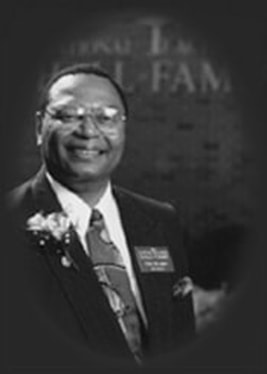
His Story
Tommy Delaney earned his B.S. from Tuskegee University in 1969, a T-4 teaching certification from West Georgia College in 1970, and his M.Ed. (T-5 certification) from Columbus College in 1979, later adding graduate coursework at Auburn University and, in the years leading up to his nomination, Ph.D. coursework at what is now Georgia Southwestern State University. He began teaching in 1969, just out of college, married with a one-year-old child, because, as he put it, he needed the job. He taught English at Troup County Schools (1969-76) and then reading and English to adults at the Georgia Department of Corrections (1976-82), before a year teaching learning-disabled students at Meriwether County Schools. In 1983 he moved to the Georgia Department of Children and Youth Services, where for the next thirteen years he taught English, speech, drama, and journalism to incarcerated teenage boys, grades 8 through 12, at the Lorenzo Benn Youth Development Campus in Atlanta — a job that, by his own account, had become less something he needed and more something that needed him, as he drove 160 miles round trip each day to reach his students.
Delaney’s students at Lorenzo Benn were an all-male population of more than 120 teenagers, many of them victims of physical and sexual abuse before their own incarceration, some as young as fourteen serving long sentences for assault, rape, or murder. Working with them, Delaney built a reputation for turning around students that public schools and the juvenile system alike had given up on: he taught Shakespeare to students previously labeled “slow” until they came to quote his work from memory, coached public speaking that took students who had never spoken publicly in their lives to state-level competitions, and built a literary magazine, “Reaching Out,” with a circulation stretching from Canada to New Mexico. The Atlanta Journal & Constitution described his approach as “compassionate and effective”; an Associated Press writer observed that “Along the way, Delaney becomes a father figure, using his English lessons to teach values”; Learning Magazine called his pedagogical style “refreshing and innovative.”
His honors accumulated steadily across a career spent almost entirely with the students public education had already written off: Learning Magazine and Michigan State University named him among America’s top twenty middle and high school teachers, presenting him with their “Professional Best Award” and a thousand dollars, in 1989; the National Board for Professional Teaching Standards recognized him in 1992 as “an effective and innovative teacher” and appointed him to two of its advisory committees, on which he served continuously for more than three years; the Georgia Department of Children and Youth Services Staff Development Division named him its Outstanding Trainer/Facilitator for 1993; the Walt Disney Company selected him, on its internationally televised American Teacher Award Show, as the Outstanding English Teacher of 1994; and in 1995 alone he was honored by a Georgia Legislature resolution for “Outstanding Lifetime Achievements in Teaching,” named an Atlanta Journal-Constitution “Honor Teacher,” given plaques from both the DCYS Campus Operations Division and the DCYS Board, and selected by the Milken Family Foundation for its National Educator Award — one of the top five educators recognized in Georgia that year, with a $25,000 check presented at a May 1996 education conference in Los Angeles.
Beyond the Classroom
What began as an activity in Delaney’s public speaking classes grew into the annual “Stop the Violence” student drama and lecture series, which toured Georgia’s public schools, boys’ and girls’ clubs, and other youth detention facilities each spring with a message against violence and drug abuse written and performed by his own students — many of them incarcerated teenagers speaking with an “inside” authority the media and Atlanta officials increasingly sought out to help fight the city’s rising youth crime problem. One student’s public-speaking skills, honed in Delaney’s classroom, earned him the right to represent the state of Georgia in Washington, D.C. while he was still incarcerated. His students’ original street adaptation of Hamlet, “The Prince of Denmark Meets the Boys in the Hood,” which transplanted the play’s themes of vengeance and family violence into a government housing project in Southwest Atlanta, became the most requested piece in their theatrical repertoire and was taped by Ivanhoe Broadcasting and aired nationally as part of the “Crack Down on Crimes” series in 1995.
In 1995, Delaney received a mini-grant funding an interactive educational television project built on the Georgia Statewide Academic and Medical System’s distance-learning broadcasting equipment, reaching more than four thousand incarcerated youth scattered across Georgia and raising the quality of training for more than nineteen hundred DCYS employees — the first Youth Development Campus program of its kind to become operational. He also designed TACT — Transition and Communication Training — a communication and conflict-resolution curriculum for aggressive students frequently assigned to detention, aimed at changing attitudes about violence and strengthening the social skills that would let students fit back into the general school population. As a motivational speaker and seminar facilitator on correctional education, he was a frequent keynote speaker nationally: before the Disney Award Selection Committee in Washington (1994), the National School Board Conference in Detroit (1995), the Georgia State Capitol legislature and the “100 Black Men Conference” (both 1995), and the Milken Family Foundation’s National Educator Awards Ceremony in Atlanta (1995), among many others, while also serving as a regular trainer for the Georgia Department of Children and Youth Services, the Georgia Police Academy, the Georgia Department of Corrections, the Georgia Department of Human Resources, the Atlanta Urban League Youth Intervention Program, and the National Board for Professional Teaching Standards.
Philosophy Into Practice
Delaney rejected the labels his unusual assignment had earned him — “at risk” English teacher, “delinquent” teacher, “troubled children” teacher — insisting instead that he was first and foremost a teacher of children, full stop. He believed every child had a right to know what it felt like to belong to something noble and good rather than be at odds with society, and built his teaching around helping students “connect” — functionally, through communication skills, and aesthetically, through theater, public speaking, and creative writing. He was candid that loving students who had been taught by harsh abuse not to respect adults was never easy, but insisted those students were exactly the ones who needed him most.
In practice, that meant meeting students where the “streets” had left them rather than where his lesson plans assumed they would be — bringing in successful professionals who had grown up in similarly rough neighborhoods to speak with his students, and, famously, allowing his class to reinterpret Hamlet in contemporary street vernacular rather than insisting on strict fidelity to Elizabethan English, once he saw that his underlying learning objectives were still being met. He measured his own success not by how he shined in front of a classroom, but by how well he got his students to shine.
“I believe that every child has a right to know what it feels like to belong to something noble and good, to be a part of society and not to be at odds with it. That’s why I strive to ‘connect’ my students functionally by teaching them proper communication skills, and to connect them aesthetically by getting them involved in the theater, public speaking and creative writing.”— from his essay, “Philosophy of Teaching”
“A teacher isn’t judged by how he shines in the classroom, but how he gets his students to shine… A child [especially an abused child] doesn’t care how much you know until he knows how much you care.”— from his essay, “Philosophy of Teaching”
In His Own Words
“A young reporter visiting my classroom once observed: ‘You teach convicted felons, academically unmotivated dissidents whom they have expelled from public schools because of their aggression and incorrigibility. Despite that you still love teaching?’ I answered, ‘No, it’s because of that I still love teaching!'”— from his essay, “Philosophy of Teaching”
“I travel 160 miles a day to educate incarcerated juveniles because now… the job needs me… So, why do I choose to teach in a juvenile prison? If I don’t do it, who will?”— from his essay, “Professional Biography”
“I swallow my pedagogical pride, and I go to the ‘streets.’ I find successful business men — doctors, lawyers, engineers — who are willing to share how they too grew up in rough neighborhoods… When the cold, incredulous stares melt into warm rays of hope, then I open the textbooks and announce: ‘Now, I’m going to show you how you can get there from here.'”— from his essay, “In the Classroom”
“To the extent that they can write and dramatize their pains and anxieties, to the extent that they can speak about their hopes and aspirations, then they are less likely to revert to violence and crime as their means of expression.”— from his essay, “In the Classroom”
What Others Said
“It is so refreshing for me to have the pleasure and honor of working with Tom Delaney. Not only does he see the mistakes and blemishes of the youth he serves, he also sees the potential. And because he sees ‘what can be’, he has personally reclaimed hundreds of Georgia’s youth from further trouble by uplifting and inspiring them.”— Eugene P. Walker, Ph.D., Commissioner, Georgia Department of Children and Youth Services
“There are academic instructors in our agency who teach because it is a job. But the very best teachers have a passion to turn around troubled lives. Thomas Delaney is one of the exceptions… I have spent over 34 years as a professional educator and I can honestly say that I have never met a teacher who has inspired me more than Tom Delaney.”— Eleanor C. Main, Secretary, DCYS Board, and Associate Vice President for Graduate Studies, Emory University
“Most of the children sent to us are functioning below grade level and often have not been in a formal classroom for one to two years… By utilizing the universal themes in Shakespeare’s plays and converting them to contemporary street language, Tom has gotten students excited by the insights they gain from a previously boring and ‘difficult’ subject.”— G. E. Fisher, Director, Lorenzo Benn Youth Development Campus
“The students that he serves are incarcerated. But he treats them as if they were in a ‘regular school’… During my short tenure as principal at Lorenzo Benn, Mr. Delaney has never had to refer a student to me or to security for disciplinary action. His students are eager to learn and are always on task because of his well-organized lessons.”— Robert Lowe, Principal, Lorenzo Benn Youth Development Campus
“I have known Mr. Tom Delaney since he was in elementary school. I was his teacher and his principal… His career has extended over almost three decades and each year seems to be marked by even greater accomplishments. I can think of no candidate more deserving of recognition in the National Teachers Hall of Fame than Tommy Delaney.”— Oliver Greene, Retired Education Administrator