
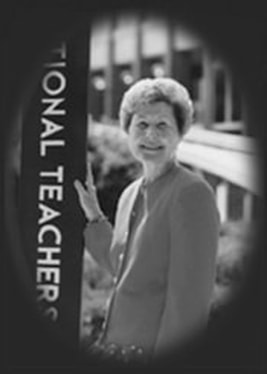
Her Story
Shirley Naples traced her love of teaching back to her own father, who lacked a formal education but taught her “wonder” and self-worth — reciting poetry, telling stories, and teaching her to read the Bible before she ever set foot in a schoolhouse. That early influence shaped a belief she carried into her own classroom: that one person can make a difference, a philosophy she said she instilled in her students “by what I say and by what I do.”
Her career began in social studies at the junior high level (Lincoln and Coolidge Junior Highs) before she moved into elementary education at Wilson Elementary in Ferndale, Michigan, eventually becoming a resource room teacher. Along the way she studied abroad twice — infant and primary schools in England (1979–80) and village schools in India (1987–88) — experiences she brought directly back into her own classroom.
She often pointed to her own seventh-grade teacher, Betty Skidmore, as the reason she believed so strongly in student self-esteem. Skidmore had given her a small gold key as a token of encouragement — one Naples said she still kept, 42 years later — and Naples credited that simple act of belief with making her own motivation “the controlling factor” in her life from then on.
Her heritage is Cherokee, and she made a point throughout her career of helping students understand Native American culture beyond the “cowboys and indians” myth, drawing on a personal library of materials on Indian history and life.
She counted several other mentors as major influences on her teaching, including Dr. Fritz Redl of Wayne State University, George and Annamarie Roeper of the Roeper City and Country School, and reading specialist Dr. Dorsey Hammond — crediting them with shaping how she understood and interacted with children.
She considered her most important contribution to be her work with immigrant “boat children” who arrived in her district in large numbers in the early 1970s — many of them teenagers who had never attended school and spoke no English. She built materials to teach them key vocabulary, visited their homes to help parents adjust to the community, found them medical care and part-time jobs, and later helped secure college placement and scholarships as they grew older.
Beyond the Classroom
Naples brought the wider world into her classroom deliberately. Having traveled extensively — England, Scotland, France, Italy, Egypt, India, Canada, and most of the United States — she filled her room with artifacts from each trip: an Egyptian alphabet, scarabs, crystals, corals, starfish, and petrified wood, all meant to be handled and wondered over. She also brought people into the room, hosting guests ranging from the Speaker of the Indian Parliament, Dr. BalRam Jakhar, to a social studies teacher from Siberia, local historians, senators, doctors, and poets.
She was known at Wilson School as the “plant lady,” running a yearly plant sale with her students to raise money for the PTA, and she trained numerous student teachers over her career, staying in touch with many of them long after their placements ended. She chaired the district’s Professional Staff Development Policy Board from its founding in 1979, represented her staff at state and local education meetings, and served on national accreditation teams evaluating teacher education programs at universities.
Her community involvement centered on children well beyond her own classroom. As a young woman she led a chapter of Beta Sigma Phi, organizing outings and Christmas parties for abused and homeless children from the county youth home and a school for children with intellectual disabilities. As a parent, she served as PTA president for her daughters’ school and later sat on its school board, raising money for its endowment. Once her own children were grown, she found summer camps for students in need, arranged for musical instruments and clothing they couldn’t otherwise afford — often paying for them herself — and worked closely with community agencies on their behalf. She remained active with Delta Kappa Gamma, a society of professional educators, supporting local causes such as Haven House, a residential home for battered and abused women and children.
Her Philosophy in the Classroom
Naples believed that self-esteem, not curriculum, was the true starting point for learning:
“The key to all successful teaching is the initial development of self esteem in every student. Children cannot learn if they do not believe in themselves… I have high expectations for every child and will not accept less.”— from her Philosophy of Teaching statement
That belief showed up in a classroom ritual she repeated every year: telling students on the first day that they were the “best” class, then handing responsibility for living up to it back to them.
“I told them that their parents paid me a lot of money to teach school and that I would not be a baby-sitter… I presented options of self-control and self-motivation. I would teach; their job would be to learn.”— from her essay, “Personal Teaching Style”
She wrote about the responsibility of teachers not just to their own students, but to the country as a whole:
“America has entrusted its future to me… to me and my fellow teachers across the nation. Ours is an enormous challenge and an awe-inspiring responsibility… Our children are tomorrow’s leaders, workers and voters.”— from her essay, “A Classroom Teacher”
What Others Said
“Mrs. Naples is the best motivator of children that I have observed in 31 years. She gives her students a sense of self worth, dignity, and confidence.”— Robert Corsini, Wilson School Principal (Nominator)
“It was Mrs. Naples who helped me adjust and feel accepted in the mainstream of American life… I cannot imagine surviving my high school years without Mrs. Naples… More than anyone else, I credit Mrs. Naples with making my life productive.”— LySing Ung, Former Student
“We believe that Shirley Naples is a master teacher. She involves and excites her children about learning by providing the optimal combination of learning, creativity and enjoyment in the classroom. She is loved and respected by students, parents and peers.”— Ferndale Schools Elementary Principals: Stewart Dilly, Debbra Lang, Jeanne McIntyre, Robert Corsini
“She modeled the epitome of what a teacher is: An attention getter, Motivator, Character Builder and Dream Molder.”— Danielle M. Dillon, Former Student Teacher