
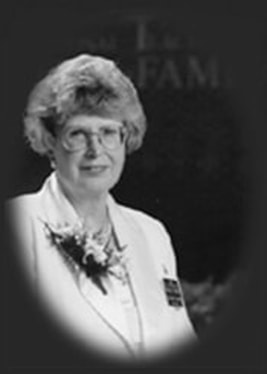
Her Story
Sallie Langseth is learning disabled — mildly hyperactive, dyslexic, gifted and talented, all conditions that went undiagnosed when she was a student in the 1950s. Her dyslexia showed up as a spelling disability so severe that, as a young girl asked by an elementary school teacher to look up a word she could not spell, she didn’t even know where in the dictionary to begin — and was too embarrassed to admit it, so she stood turning pages, pretending to search. When she was twelve, her father became totally disabled with a heart condition, before Social Security disability or many of the other programs that help families today. Her mother took in babysitting, sewing, and washing to make ends meet, and all three children contributed to the family’s income; Langseth remembers the utilities being shut off, nearly losing the family’s house, and receiving a Thanksgiving Needy Family Basket from her church. She wanted to be a teacher from as early as she can recall, and built a 28-year career at Deer Park High School, the last 24 of them there, rising to chair of the school’s mathematics department.
Every year Langseth chose to teach both ends of the spectrum: Advanced Placement Calculus, equivalent to a second semester of college calculus, alongside the school’s most at-risk mathematics course — an inclusion pre-algebra class whose roster in one year included an autistic student, seven emotionally disturbed students, five students with various learning disabilities, and a group of “normal” students who were nonetheless two years behind in math. Her AP students have gone on to receive college credit at institutions from MIT to Sam Houston State University, while her at-risk students have been guided toward passing the mathematics exam Texas requires for graduation. Her response to being asked how she reaches such a wide range of ability is always the same: “I teach one child at a time.”
Langseth’s honors reflected that same range of impact: her peers named her Deer Park Independent School District’s 1993-94 Teacher of the Year, after which she was named Texas’ Teacher of the Year for Secondary Education. During the year of her nomination, the district asked her to take on improving the mathematics program district-wide, from kindergarten through 12th grade, on top of her own high school teaching load — work to which, her superintendent noted, she devoted an untold number of hours above and beyond the call of duty.
Beyond the Classroom
Langseth and her students built a homework hot line and a schoolwide tutor list at the start of every year, distributed to every student in the high school and shared with counselors at the district’s junior highs and elementary schools as a resource for any student in need. Because Texas requires students to pass a math exit exam to graduate, her students organized a volunteer “buddy system” pairing strong math students with those who were mathematically at-risk — a pairing that built self-esteem in the students receiving help and taught civic responsibility to the students giving it. With Deer Park’s Hispanic population growing, and aware that Hispanic students statistically underperformed on standardized math tests, she and her students identified bilingual students to mentor other bilingual students, helping them feel comfortable with math, translating vocabulary, and demonstrating that all students could achieve.
She co-sponsored the school’s math club, which competed in mathematics contests and took on its own community projects: collecting canned food for the needy, visiting local nursing homes, and helping with community beautification. Outside of school, Langseth and her husband established a Habitat for Humanity project in their community to build housing for families living in substandard conditions — work she connected directly to her own childhood, since, as she put it, it is hard to concentrate on an education without a decent place to live. She held office hours that ran from before 6:00 a.m. until the last student left her room in the afternoon, gave every student her home telephone number on the first day of school (with a single rule — no calls after 10:00 p.m., a rule she said no student ever abused in 28 years), regularly opened her home for weekend tutoring sessions with snacks, held an optional study session at her house the night before the AP exam each year, and placed a personal phone call to every AP student to congratulate them once scores came back — fielding math questions over the phone from former students at colleges as far away as Hawaii.
Philosophy Into Practice
Langseth’s philosophy of teaching grew directly out of her own experience as a learning-disabled, gifted, and economically disadvantaged student: she believes that life’s abilities and disabilities do not have to stand in the way of life’s achievements and dreams, and she shares her own story openly with her students to make that point real. Her goal, she says, is not to teach mathematics but to motivate students to be all that they can be — helping them build self-esteem, face their own abilities and disabilities honestly, and use their particular characteristics as stepping stones rather than obstacles.
In practice, that meant refusing to treat her classroom as one-size-fits-all. She taught to visual and auditory learners simultaneously, physically acting out concepts — hopping across the room like a rabbit to demonstrate the absolute value of sine — alongside the equations on the board, and kept four or five different activities running in her classroom at once so that gifted students and students with severe disabilities could each be met where they were. She welcomed parents, community members, and industry professionals into her classroom as regular resources, believing, as she put it, that it “takes the whole tribe to educate a child,” and made a point of calling parents with good news as well as bad, to build trust between school and home.
“Because of my background, I feel that my main goal in teaching is not to teach mathematics; but to motivate students to be all that they can be… I try very hard to help students build self-esteem, face abilities and disabilities, and use their characteristics as stepping stones to move on to life’s opportunities.”— from her essay, “Philosophy of Teaching”
“Teachers should always remember that they do not just teach a subject; they teach the whole child.”— from her essay, “In the Classroom”
In Her Own Words
“I am learning disabled. If there had been adequate diagnostic methods in the 1950’s, I would have been diagnosed as mildly hyperactive, dyslexic, gifted and talented, and economically disadvantaged. I freely share with my students that these conditions existed in my life as a student.”— from her essay, “Philosophy of Teaching”
“When a student and a teacher work together, there are no limits to what the student can achieve and who the student can be… I have never been bored with teaching. Every day I learn something new about math and children.”— from her essay, “Philosophy of Teaching”
“Teaching is not an eight-hour job worked five days a week. Teaching is a whole lifestyle… Once you are one of my ‘kids,’ you are my ‘kid’ for life.”— from her essay, “In the Classroom”
“My answer is the same for all children — ‘I teach one child at a time.’ There are no ‘cookie cutter’ kids. All children are different. An effective teacher meets the needs of children on an individual basis.”— from her essay, “In the Classroom”
“God gives everyone certain talents. With these gifts come responsibilities… One must give back to the community in which he lives. I try very hard to show my students that everyone has this responsibility and that we all have different talents to share.”— from her essay, “Outside the Classroom”
What Others Said
“Sallie is, in my opinion, one of the most caring, dedicated, and professional teachers I have ever known. Her commitment to mathematics and students is evidenced through her willingness to tutor students before and after school in addition to having them come to her house for study sessions that include snacks.”— David Hicks, Ed.D., Superintendent, Deer Park Independent School District
“When the word TEACHER was created, it must have come with the vision of someone like Sallie. I am extremely proud and honored to recommend Sallie Langseth for induction into the National Teachers Hall of Fame.”— Bobby Grisham, Assistant to the Superintendent, Deer Park ISD
“Sallie’s first love and commitment is to her students… the desire to remain in school and the pride of accomplishment experienced by our at-risk students continue to be Mrs. Langseth’s forte… Above all, Sallie’s love for children is most important. Never have I observed her to be too busy to work with a student, share concerns, or take time to listen.”— Floyd A. Burden, Ed.D., Principal, Deer Park High School South Campus
“Mrs. Langseth taught both visual and auditory learners at the same time… She could make the hardest calculus problem as simple as a second grade math problem through her unique way of teaching, allowing all students in the class to understand.”— Elaine Carmichael, Parent
“In August 1989 I wandered into a high school calculus classroom and met Sallie Langseth. I had no idea then that she would become one of the most influential people in my career… On the day I informed her I was preparing to teach mathematics, she ran over and hugged me like a son.”— K. Shane May, Teacher, Deer Park High School, and former student
“As a 1995 graduate of Deer Park High School, I would like to comment on Mrs. Langseth’s dedication and ability as an AP calculus teacher… Along with teaching calculus, Mrs. Langseth inspires and encourages her students to set goals and achieve them. She should be recognized as the 1996 ‘unsung HERO’ and inducted into the National Teachers Hall of Fame.”— Arianne Chavez, former student