
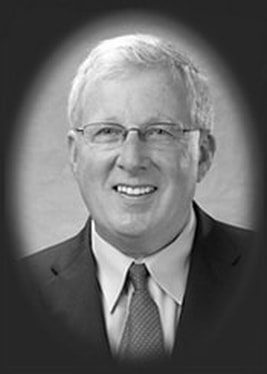
His Story
Norm Conard calls teaching “a lifework, not a job, not even a career.” He chose it out of a love for young people, enjoyment of his academic subjects, family members in education, and “a recognized opportunity to make a difference in the world.” His mother taught in a one-room school like the one he attended. He earned a bachelor’s degree in sociology from Azusa Pacific University (1970), a master’s in education from Pepperdine University (1976) and a second master’s in history from Pittsburg State University (1990), and became a National Board Certified Teacher in social studies in 2001.
He taught social studies at Maranatha High School (1976–1981) and L.A.B. High School (1981–1985) before joining Uniontown High School in 1987, where he has taught U.S. history, government and creative social studies to students in grades 9–12. Uniontown is a rural Kansas high school of about 120 students in a town of 8,200 with little diversity. His classroom walls are covered with murals, a primary source library, and displays of his students’ diversity projects, and his students have produced more than 40 films on multicultural topics.
His honors include Kansas Teacher of the Year (1992), the Milken Family Foundation National Educator Award (1992), a USA TODAY All-USA Teacher Team award (2000), National Social Studies Secondary Teacher of the Year, the NEA Civil Rights Award (2003), Northern Life’s “100 Most Influential Educators in America” (2000), the Kansas Governor’s Award for Excellence in Education (2004) and the first Irena Sendler Award, presented in Warsaw, Poland.
Beyond the Classroom
In the fall of 1999 Conard encouraged four students to take on a National History Day project about an unknown figure. They found a small clipping about Irena Sendler, a non-Jewish social worker who went into the Warsaw Ghetto in 1942–43, persuaded Jewish parents to give up their children and rescued some 2,500 of them, hiding lists of their names in jars so that someday she could tell them who they were. The students wrote a drama called Life in a Jar, discovered that Sendler was still alive in Poland, raised money to help her, and traveled with Conard to meet her. The play has been performed more than 200 times, and the students’ website, irenasendler.org, has had millions of hits. The project has been covered by CNN, C-SPAN, National Public Radio, CBS and USA Today, and made Sendler a national hero in Poland. Two of the original students have become teachers.
His students have developed more than 80 dramas, documentaries and exhibits that teach respect for diversity, including a film by Heather about Elizabeth Eckford of the Little Rock Nine that helped her reunite with a white classmate who befriended her. They have won more than 150 Kansas History Day championships and 49 national winners, and his student filmmakers have won more than 50 state, regional and national awards. The class motto, “to repair the world,” comes from the Talmud: “He who changes one person, changes the world entire.”
Conard served for ten years on the TIME Magazine Educational Advisory Board, helped produce teaching guides with TIME and HBO (Band of Brothers), and has spoken at conferences across the country. In the early 1990s he worked with Senators Nancy Kassebaum and Ted Kennedy on the Educate America Act, he has testified before Kansas legislative education committees, and he has taught the student teachers’ class at a nearby university. He directs “Celebration of Teaching” days, started a Future Teachers program at his school, and advises the National Honor Society.
Philosophy Into Practice
Conard’s teaching crosses disciplines and stresses independent study, communication, problem solving and technology, and works to make students “believe in their own abilities.” His students help write the class objectives and prepare the exams, and learn through cooperative groups, role playing, simulations and electronic portfolios. Each student also completes a performance assessment project using primary sources, often on a multicultural topic, and he evaluates them on “changed attitudes” as well as results.
He is proud of the numbers, including state assessment scores in social studies that were the highest in his area of Kansas, but says “test scores alone do not measure success.” He believes history is “a journey, not merely something to be read in textbooks and then forgotten.”
“He who changes one person, changes the world entire.”— Classroom motto, paraphrased from the Talmud
“I believe each student should be challenged to achieve higher levels of learning and challenged to develop creativity and critical thinking.”— Norman Conard
In His Own Words
“The teaching profession is a lifework, not a job, not even a career.”— Norman Conard
“My learning process should and will never stop.”— Norman Conard
“History is a journey, not merely something to be read in textbooks and then forgotten.”— Norman Conard
“A quality teacher builds a fire inside the lives of his students and builds a fire inside other teachers.”— Norman Conard
“A quality teacher points to our high standards and higher dreams.”— Norman Conard
“Test scores alone do not measure success and accountability.”— Norman Conard
What Others Said
“Mr. Conard exemplifies teaching excellence.”— Kimberly A. Thomas, nominator
“Norm has spent much of his adult life converting students and teachers to being true believers in education.”— Bart Altenbernd, Assistant Principal, Westridge Middle School, and former Uniontown principal
“I would place Norm Conard in the top five of that elite group.”— Foley, Senior Vice President, Milken Educator Awards, Milken Family Foundation
“Mr. Conard is a man of integrity, passion, compassion, and has the ability to make a life changing difference in the life of every individual he comes into contact.”— Randy Rockhold, Superintendent, Uniontown USD 235
“Mr. Conard is on a journey of great teaching, he is picking up passengers along the way. I am proud to say, “I am a passenger.””— Megan Stewart-Felt, former student
“Norm exemplifies the concept of teacher as one who empowers and facilitates students to accomplish more than they ever imagined was possible.”— Blake West, Ed.D., President, Kansas National Education Association