
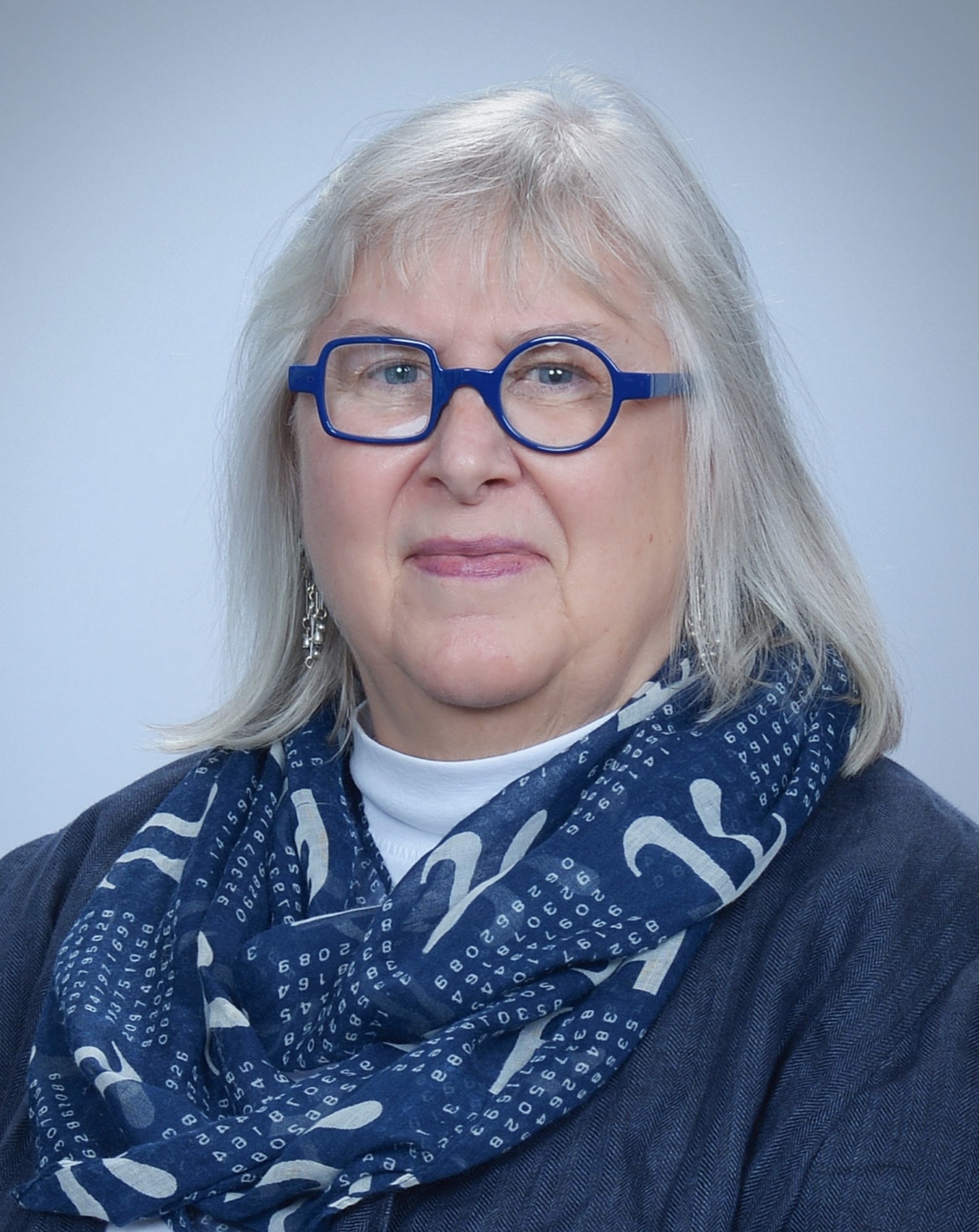
Her Story
Peg Cagle came to teaching late, after fifteen years as an architect. A cross-country move left her starting over professionally, and she began teaching at local colleges to build a network. What began as a marketing idea turned into a passion. California was short of math teachers and was offering emergency credentials to STEM professionals, so she became a teacher in a large urban district. She earned a clear secondary mathematics credential from Cal State Northridge in 1998 and a master’s in secondary math education there in 2004, plus a specialist certificate in gifted education from Cal Lutheran in 2002.
She has taught in Los Angeles Unified for most of her career, in middle school from 1993 to 2011 teaching mathematics, science and French, and in high school since 2016. She spent three years as a teacher in residence at Vanderbilt University, teaching undergraduate and master’s courses in math education. She was LAUSD and Los Angeles County Teacher of the Year in 2008, received the Presidential Award for Excellence in Mathematics and Science Teaching in 2005, and was named to the USA Today All-USA Teacher Team in 2007. In 2019 she received the George Polya Memorial Award.
Beyond the Classroom
Cagle was an Albert Einstein Distinguished Educator Fellow in the office of Senator Kirsten Gillibrand in 2011, where she worked on federal education policy. She was the only practicing math teacher contributing to a presidential advisory council report on K-12 STEM education that recommended a national STEM Master Teacher Corps, a proposal later funded as pilots. She also served on a National Academies committee comparing teacher careers and K-12 pedagogy in the U.S., China and Australia, and has held leadership roles with the California Math Council, the National Council of Teachers of Mathematics and the Council of Presidential Awardees in Mathematics.
She spends her summers doing mathematics at the Park City Mathematics Institute, and she regularly works as a visiting mathematician and artist at the Math-on-a-Stick exhibit at the Minnesota State Fair, helping the public see math differently. Her colleagues credit her with shifting instruction across her middle and high schools through lesson study and curriculum pilots.
Philosophy Into Practice
On the first day of geometry Cagle hands out lots of paper cups and asks students to imagine what someone might wonder about as a cup rolls, then asks “how might you convince someone of your idea?” The activity grew out of a lunch at the Park City Mathematics Institute, and a former student recalls that it put everyone “on an even playing field.” She tells students she spends her summers doing math because it is what she loves.
Her classroom features “a few of the many mathematical smartnesses,” a display that began with 18 and now has 40, each linked to a mathematician, and students identify which ones they or classmates show. She rarely answers questions directly and encourages students to ask each other, and she posts student work without names so mistakes become everyone’s opportunity to think. Students tell her hers was the first class where they were chastised for not talking enough.
“Ask a good question – everyone starts thinking. Answer it – everyone stops.”Peg Cagle
In Her Own Words
“Students should instead be encouraged to view learning mathematics as participating in a mud festival; messy, sometimes elusive, but relentlessly invigorating.”Peg Cagle
“My ultimate goal is for students to learn how to learn.”Peg Cagle
“One learns not by listening nor by watching nor even doing, but by thinking about and communicating what was done.”Peg Cagle
What Others Said
“In all my years as an educator with LAUSD, I have not met another mathematician as dedicated, nor one who so powerfully shares her passion and innovative approaches to mathematics instruction.”Stacy Tanaka, magnet coordinator, Reseda Charter Science Magnet
“She stood out for her voracious curiosity, deep content and classroom knowledge, as well as her warmth and humor.”Ilana Horn, Wachtmeister Family Chair of Teaching and Learning, Vanderbilt University
“Peg is the teacher I wish my own children could have, the advocate educators deserve, and the mentor who supports my own growth as a teacher.”Leslie K. Hicks, colleague
“She believed deeply that mathematics should be experienced, explored, and connected, not memorized and then subsequently dumped onto a piece of paper for a grade.”Adrian K. Waller, former student