
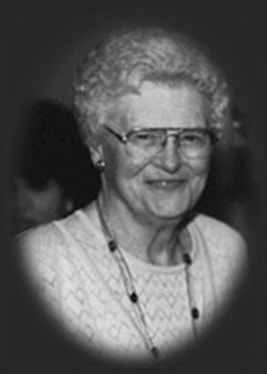
Her Story
Helen Case began teaching in a one-room rural school called Happy Valley, on a hill five and a half miles northeast of El Dorado, Kansas — the very school where she’d attended her own first eight years of classes. She once dreamed of becoming a doctor, but limited family finances, and deep admiration for her own seventh and eighth grade teacher, turned her toward teaching instead. At just 17 years old, armed with a Normal Training Certificate and eight hours of college credit, she took charge of 24 students spanning all eight grades in the rural schools of Butler County.
After eight years in rural schools, she moved to El Dorado, teaching second grade, then fifth grade, then junior high science, math, and history — attending Kansas State Teachers College every summer for fourteen years before finally earning her B.S. degree in 1941. Her personal life brought real hardship in these years: after her mother became an invalid, she worked summers at a feed store and as a grocery checker to help pay the bills, and in 1953 both her mother and her only sibling passed away. That same year, she moved to El Dorado Senior High as a Social Studies and Government teacher, eventually becoming head of the Social Studies Department and head senior class sponsor for eighteen years, all while completing a Master’s degree in counseling with night classes and a summer fellowship at Purdue.
In 1961 she was named Kansas Teacher of the Year and spent two days being interviewed and observed as a candidate for National Teacher of the Year, ultimately being named one of the top eight finalists nationally by McCall’s magazine. She retired from the classroom in 1973 after 45 years, calling it “a fitting closure” to her professional teaching career — though her involvement in education was far from finished.
Beyond the Classroom
Case considered extra-class activities essential teaching tools in their own right — selling tickets at basketball games, running the concession stand, popping what she called “bushels” of popcorn for out-of-town football games, and running Student Council elections patterned deliberately after real ones, complete with voter registration and counting boards. As head senior sponsor, she organized Senior Day trips to the lake by the busload — and was thrown in more than once, “all in fun.”
After retiring from the classroom, she was elected to the USD 490 Board of Education in 1975 and served twelve years — two as vice-president, four as president — while also serving as the district’s chief negotiator. Her leadership in the teaching profession reached the national level: she served sixteen years on the Board of Directors of the Kansas State Teachers’ Association, becoming the first classroom teacher elected as its vice-president and then president, and went on to the Board of Directors of the National Education Association, where she chaired the NEA’s Task Force on Drug Education and directed its widely publicized report, “Drug Education: An Awakening.” She was invited to Universal Studios to review the educational soundness of drug education films, selected for a six-member panel with the Aerosol Education Bureau in Washington, D.C., and elected one of nine Kansas delegates to help rewrite the NEA Constitution at its 1971 convention.
Her community involvement was just as extensive: president of the Butler County chapter of UNESCO, chairperson of the American Field Service chapter that organized international student exchanges, president of Business and Professional Women, the American Association of University Women, Butler County Retired Teachers, Friends of the Library, and Delta Kappa Gamma, and secretary-treasurer of the El Dorado Knife and Fork Club for fifteen years. She personally edited and compiled a pamphlet on the lives of Butler County women, placing copies in every library in the county, and helped pass both a city sales tax and a $4.5 million school bond issue. She remained deeply active in her church as well, serving as Vice-Moderator and Moderator of the Christian Church in Kansas and holding nearly every leadership role available to a woman in her congregation.
Philosophy Into Action
Case believed teaching was closer to a calling than a job — not something suited to “the faint-hearted, the indecisive, the timid, the believer in the status quo.” She insisted that an effective teacher had to constantly renew their methods and never assume they’d “arrived”:
“An effective classroom teacher cannot, at any time, feel he/she ‘has arrived’ with no need for improvement, but spends his/her entire teaching career ‘Becoming.'”— from her essay, “The Art/Science of Teaching”
That philosophy showed up directly in her classroom methods. Long before they became standard educational practice, she staged simulated court trials with students playing every role from defendant to jury, ran mock sessions of Congress complete with bill-writing and vetoes, delivered a researched State of the Union address to her class, and piped a rotating student-run current events newscast into the room each week. Her nominator, colleague Jim Gardner, confirmed this was no exaggeration: she “used various teaching methods — many of them before they became the educational watch word.”
In Her Own Words
“A master classroom teacher never says, ‘I’m just a teacher,’ but proudly proclaims, ‘I am a teacher,’ and that’s the way I answered the question, ‘What do you do?'”— from her essay, “A Classroom Teacher”
“One could certainly equate teaching with the medical profession. Doctors heal bodies and minds to the best of their ability; effective teachers take those minds and bodies and, whatever their ability, through effort, patience, motivation and evaluation, give them the tools needed to face the society which they inherited.”— from her essay, “A Classroom Teacher”
What Others Said
“Helen’s most significant impact on her students was her high expectation that every student could learn and could succeed in her classroom. Helen always looked for creative ways to involve all students. They could sense her sincerity, dedication and caring.”— James C. Gardner, Nominator, President of El Dorado NEA
“Whenever I think of Helen Case, I am reminded of the movie Our Miss Dove. The movie could have been written about Helen. Helen’s former students are now her minister, doctor, lawyers, bankers, teachers, nurses, and business people… El Dorado is indebted to ‘Our Miss Case.'”— Jim C. Gardner, with the USD 490 Board of Education
“Miss Case was my eighth grade social studies teacher, and I was fortunate to have her again as a teacher of American Government in high school… I especially admired how she expected the BEST from each one of us, and she got it!”— Rosemary Emerick, Former Student, Principal, Whittier Elementary School
“Her abiding concern was ‘what is best for the students.’ It seemed that no matter where I would travel someone would ask about Helen and share with me what she had meant to them… She helped me personally grow and mature as an educator through gentle suggestion, patience, consistent support, and a persistent attitude that declared ‘I care about you.'”— Andy Tompkins, Superintendent, Salina Public Schools (former El Dorado Superintendent)