
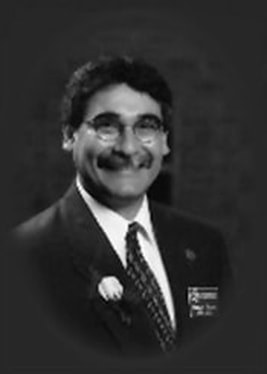
His Story
Hector Ibarra was born in a one-room schoolhouse in Mexico, where his mother, Ida, taught — the first and most important of the many teachers who shaped him. His early school years in the United States were difficult: he didn’t speak much English, and the summer before fourth grade his family survived a boating accident in which his sister drowned. It was his fourth-grade teacher, Ms. Myrtle Olson, who saw something in him during that hard year and became the first person outside his parents to believe in his abilities. By tenth grade, inspired by a memorable biology teacher, Mr. Gilbert, Ibarra knew he wanted to teach science himself. He earned his Bachelor of Science in Secondary Science from the University of Iowa in 1975, his Master of Science in Curriculum Development in 1992, and went on to complete coursework toward a Ph.D. there as well, teaching junior high science in New London, Iowa from 1976 to 1980 before moving to West Branch Middle School, where he remained for eighteen years and counting at the time of his nomination.
At West Branch, Ibarra built a science program around student-driven, real-world environmental and energy projects rather than a textbook. His “High Efficiency Lighting Systems” project — in which students measured and compared conventional and energy-efficient lighting in a “living classroom,” then presented their data to the school board, secured a loan from a local bank, and got the entire middle school retrofitted — was cited directly by President Clinton in his October 19, 1997 address on Global Climate Change. His water and energy conservation projects have saved the district roughly 40,000 gallons of water a week and about $3,000 a year in energy costs. Over the years his classroom or its projects were honored with the EPA President’s Environmental Youth Award and Region VII National Excellence Award (1993, 1997), the U.S. Department of Energy’s Best in Category National Award for Energy Education (1996), inclusion in the Smithsonian’s Ocean Planet exhibit (1995), a Milken National Educator Award (1993), and the Presidential Award for Excellence in Science Teaching (1993), among many others. In 1997 he served as president of the National Middle Level Science Teachers Association and was named a National Teachers Hall of Fame finalist the year before his eventual nomination.
Ibarra’s students traveled far beyond West Branch as a result of his projects: presentations to the EPA in Washington, D.C., testimony before Iowa legislative committees at the State Capitol, the NSTA National Convention in St. Louis, and a trip to Tokyo, Japan, where two students, their parents, and Ibarra represented the United States at the 16th World Energy Council conference. He also received Fulbright study-abroad fellowships to Russia (1992) and Japan (1997), further fueling the international dimension of his science curriculum.
Beyond the Classroom
Ibarra treated the wider community as an extension of his classroom, building partnerships with electric utilities, banks, and local businesses so that his students’ environmental projects had real institutional stakes and real institutional partners. His “Operation Appreciation” project had students force tulip, hyacinth, and narcissus bulbs to flower out of season, then personally deliver the flowering plants, along with handwritten cards, to senior citizens in nursing homes and to the owners of local businesses who had supported his programs — turning a science lesson in plant biology into an act of community gratitude. He organized an after-school “Partners in Environmental Science” club that met during students’ own lunch periods, through which participants planted thousands of trees over a multi-year tracking project and tested stream water for nitrates, pH, hardness, and dissolved oxygen to gauge its ability to support fish.
He personally wrote grant proposals that brought in more than twenty funded projects over his career, and he shared what he learned generously — developing handbooks on his classroom projects for other schools and districts, making more than forty presentations at the district, state, regional, and national levels, and writing grants on behalf of other teachers in his district so they, too, could enrich their own classrooms. He also personally developed original educational software that let his students calculate real energy, monetary, and pollution savings from switching to more efficient devices — software later showcased nationally by the Center for Renewable Energy and Sustainable Technology as a benchmark for other teachers and students.
Philosophy Into Practice
Ibarra believed teaching was about process rather than content — that a teacher who stresses memorized facts is training students for one week’s test, while a teacher who instills the process of questioning, planning, discovering, and revising prepares students to learn for a lifetime. He rejected the idea that science was a fixed set of answers to be memorized, insisting instead that science is fundamentally a set of questions whose answers lead to still more questions. He wanted every student, regardless of reading ability, to have equal access to his hands-on, inquiry-based classroom, and he described his own evolution from a traditional lecture-based teacher into a facilitator who builds challenging, student-driven activities.
In practice, this meant his classroom operated almost entirely outside the textbook: he rewrote nearly all of his experiments himself, treated his own home and the wider community as extensions of the “living classroom,” and structured every unit so that the answers students found led them to formulate new questions and redesign their own experiments, just as working scientists do.
“Teachers represent preparation. Teachers prepare students for the world on a broad scale… Most importantly, teachers represent the easel that supports the pallet of a child’s mind.”— from his essay, “Philosophy of Teaching”
“I believe science should be more than memorizing facts. Instead science is how something gets to be known. Science helps people to grow, to develop, and to become leaders… In reality, science is a set of questions.”— from his essay, “In the Classroom”
In His Own Words
My mother, Ida, was my most important teacher. My mother was a teacher in Mexico. In fact, I was born in the one room schoolhouse in which she taught.”— from his essay, “Philosophy of Teaching”
“The summer before fourth grade my family had been in a boating accident and my sister drowned. My sister meant everything to me! That was a difficult time in my young life… My fourth grade teacher, Ms. Olson, saw something in me… She was the first person, other than my parents, who believed in my abilities and helped instill confidence and self-esteem in a young person looking for acceptance.”— from his essay, “Philosophy of Teaching”
“Status quo is not for me! Every year I look for new methods to get my message across. I love the challenges of teaching a new project… I am always tinkering with new ideas and methods that challenge students who want to take learning beyond my class.”— from his essay, “Who Are You? What Makes You Tick?”
“To have students say, ‘I didn’t know I could make a difference,’ or ‘They (adults) actually listened to my ideas,’ is so gratifying.”— from his essay, “Outside the Classroom”
“Perhaps what may be most important about me is that I like to connect with students on a personal level. I recognize that not every teacher can reach every student in this way. But if one teacher in a school can reach a student, that can be all that is needed to make a lasting impression… I try to be that teacher who makes a difference.”— from his essay, “Who Are You? What Makes You Tick?”
What Others Said
“Mr. Hector Ibarra teaches that learning is a life-long process. I can best summarize Mr. Ibarra’s strengths by saying, ‘He is a dedicated educator interested in helping the students of today become learners who will help all of our tomorrows.'”— Margaret Sadeghpour-Kramer, Nominator
“What I have found so powerfully innovative about Hector as a teacher is his focus on honing students’ skills of observation, experimentation, curiosity, and initiative as fundamental to students becoming adept in math and science and life-long learners. The entire school literally becomes a learning lab, as do their homes and community.”— Michael Totten, Executive Director, Center for Renewable Energy and Sustainable Technology
“This project was cited by President Clinton in his Oct. 19, 1997 address on Global Climate Change… The students successfully negotiated with the West Branch State Bank to provide the loan funds. The students have also negotiated with the bank to provide loans to other community businesses that will use the school plan to retrofit their locations.”— Kathryn J. Trump, Member Services Supervisor, Linn County Rural Electric Cooperative
“Hector’s teaching performance does not just meet one of the criteria for being considered for this award, but all the criteria… Twenty-nine (29) of Hector’s students made presentations to the City Council and School Board, and thirteen (13) of his students made presentations to the Environmental Protection Agency (EPA) in Washington, DC.”— W. Tony Heiting, Ph.D., State Science Consultant, Iowa Department of Education
“In sixth grade I started in Mr. Ibarra’s Science class. I was totally unprepared for the teacher I found there. The amount of hands-on activities he used to present information to his students was astonishing… He bugged me about filling out the paper work for the talented and gifted Belin-Blank summer program in Iowa City. I know that without his support and encouragement I would not have followed through with the process.”— Jillian R. Arn, Former Student
“Mr. Ibarra has taken the students’ experiences with science beyond the boundaries of the classroom and outside the constraints of the school day… In a small, rural community, where athletics have traditionally been the end-all as far as achievement is concerned, Mr. Ibarra offers a welcome break.”— Paula Verlo, Parent of a Student