
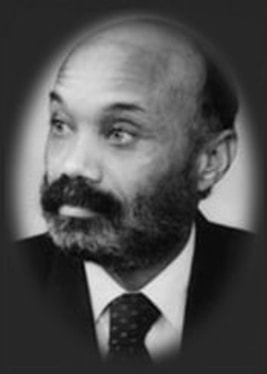
His Story
Emiel Hamberlin began his teaching career in 1964 in the Chicago Public Schools and, by the time of his nomination, had spent thirty-six years at Jean Baptiste Pointe DuSable High School on the city’s South Side. He grew up in Fayette, Mississippi, where his earliest schooling took place in a one-room schoolhouse under a teacher he remembered as “Miss Mary,” and where his family made its living on the farm. He earned his bachelor’s degree in biology from Alcorn State University in Lorman, Mississippi, then went on to a master’s degree in vocational education and a doctorate in horticulture, both at the University of Illinois at Champaign, with advanced studies at Northwestern University.
Over three and a half decades he taught nearly every secondary science course DuSable offered, with his deepest interests in horticulture, biology and environmental science. Early in his career he saw that students performed better when they were given hands-on experiences, and he built his classroom around that conviction. Together with his students he developed an award-winning Urban Ecology Sanctuary, an enclosed courtyard on the school’s campus where they studied, maintained and housed animals, plant life and unique ecosystems. Peacocks, pheasants and other exotic birds lived there, and the school’s Outdoor Rookery became known across the city. His classroom became a laboratory for every elementary school in the district, whose classes were brought in to touch and see live animals in a natural habitat for the first time.
His work drew national attention. Over the years he was named Chicago’s Teacher of the Year (1971), received the State of Illinois Those Who Excel Teacher of the Year award (1977) and the Illinois Master Teacher Award (1983), and was named one of Newsweek’s 100 American Heroes (1986). He became a Golden Apple Foundation Academy Fellow and a Kohl Family Foundation International Educator in 1992. His classes were televised over interactive cable to students across the country, and his classroom was featured on ABC’s 20/20 and in Newsweek, while his Urban Ecology Sanctuary was highlighted in the New York Times and other publications.
Beyond the Classroom
Hamberlin often said it was never easy to tell where the classroom ended and the community began. His students turned vacant, blighted lots in their neighborhood into community gardens of vegetables and flowers, cleaning the land, refertilizing it, designing and planting it, and tending it through the school year. They wrote proposals for grants from the “Youth As Resources” program to buy tools for their “Turn A Vacant Lot Around” project, and the work was so successful that seniors in the community helped keep it going for four years. At the Robert Taylor public housing complex, students worked alongside parents to decorate porches with living plants and flowers, earning Service Learning credit toward graduation, a requirement the district later adopted for every Chicago public high school student.
The Urban Ecology Sanctuary and Outdoor Learning Lab drew national acclaim and invitations to Cornell University’s School of Architecture, where students shared the project’s origin and discussed how other urban high schools might duplicate it. Hamberlin’s students also worked with the Chicago Parks District to plant Illinois wildflowers, small wetlands and wild grasses along highways, and they sold plants and arrangements through a student landscaping club and an in-school store called “DuSable’s Bloomingsales.” The Sears Roebuck Corporation even allowed him and his students to manage all plant sales for one of its Chicago stores.
At home, he describes himself as a family man, married for thirty-six years to Minnie, an elementary school teacher, with whom he raised two sons. He has served for more than twenty years on the Civic Association board in the North Beverly community where he lives, is active in the Music Committee and Board of Trustees at his church, and works on the scholarship committee of his college alumni.
Philosophy Into Practice
Hamberlin describes his philosophy in five guiding ideas: teach the child, not the subject; require discipline and order; create an exciting environment; involve learners in real-world situations; and reverse roles so that students and teacher learn from one another. He calls himself a caring teacher and a strict disciplinarian, a lesson he traces to Miss Mary and the one-room school of his childhood. His living classroom, filled with plants and animals, was built on the belief that in a stimulating environment students learn to nurture something other than themselves.
“I teach children, not subjects.”— from his essay, “Philosophy of Teaching”
“I start where the student is, and in urban areas such as where I teach, it’s not always on page one of the Biology or Horticulture Textbook.”— from his essay, “Philosophy of Teaching”
In His Own Words
“I want students to know that I can give them some knowledge and skills to protect our global environment, but what they do with their own lives is the real answer. I want students to know that I care what they do with their lives.”— from his essay, “In the Classroom”
“My second goal is to give each child under my care hope for a better future. And finally, I try to be a catalyst for change and growth in individual lives through involvement with real life situations.”— from his essay, “In the Classroom”
“I believe that the future of education in America’s cities is in the hands of teachers, and teachers must be empowered to get the job done. Teachers are effective administrators, and they can collaborate to improve schools when given the opportunity.”— from his essay, “Educational Issues”
“I am a true frontiersmen, willing speak out, to reach out, and to get in my wagon and go out where I am needed.”— from his essay, “Getting to Know You”
What Others Said
“He is the ‘Pied Piper’ of the Southside of Chicago, saving hundreds of kids lives.”— Paul Alt, Consoer Townsend Envirodyne Engineers; colleague on the Urban Ecology Sanctuary
“Dr. Hamberlin is more than a classroom teacher. He is in a very real sense an ‘education detective.’ That is he seeks to find out why ‘Johnny’ can’t come to school on time; why he can’t get his school supplies; why he sleeps in class, etc. As a matter of fact, he is a human ‘alarm clock.'”— Edna M. Hart, Assistant Principal for Extended Day Programs, DuSable High School
“He personally pays for his zoo of sixty, and just as many plants, saying his students learn to nurture their own lives when they become responsible for the life of something else.”— Janet Lagerlay, freelance writer, Hope Magazine
“He believed in me and my classmates when we did not believe in ourselves. He spent countless hours telling what great things we would be doing and how much we were needed.”— Russell Lindsey, former student
“My boys had gone too far, they were going to be dropouts but he saved them and for that I will always be thankful.”— Viola Mason, parent of DuSable students
“He is known as an ‘educational physician’ and in his science lab he mends ailing students by building their self esteem, by setting high standards, and then is willing to nurture and love, and encourage students to strive for the very best life has to offer.”— Charles E. Mingo, Retired Principal, DuSable High School