
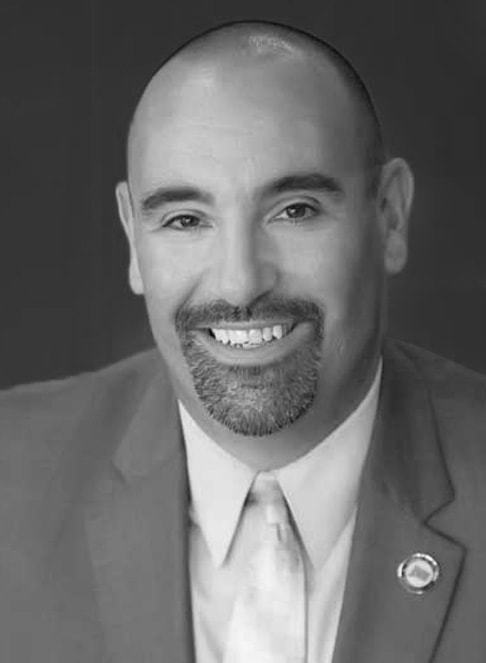
His Story
David Bosso teaches at the same high school he attended in Berlin, Connecticut. His mother was a teacher, and he says he chose teaching as a way to encourage lifelong learning, global awareness and social justice in a small town. He earned a B.A. from Eastern Connecticut State University, a master’s degree from the University of Hartford, a second master’s from Central Connecticut State University and an Ed.D. from American International College. He began teaching in 1997 at Holy Cross School in New Britain and joined Berlin High School in 1998. The principal who hired him had known him as a student, and Bosso also coached the school’s varsity basketball team to its first state championship before deciding to give up coaching to focus on teaching.
He stands at the classroom door to greet students as they enter, a gesture he says tells them “you are cared for, you are safe, you are supported, you are respected, and you have a voice here.” He replaced the four-page rules handout he once gave on the first day with four expectations: Be Respectful, Be Engaged, Be Diligent, Be Kind. His room is colorful, with flags from countries he has visited, student-designed personal flags, large paper mandalas and student prototypes that address poverty and sanitation.
A former student, now a colleague, remembers how he brought the pyramids of Egypt and the Great Wall of China into the classroom with photographs and artifacts at a time of limited technology, and taught that people’s “frames of reference” differ.
Beyond the Classroom
Bosso was the 2012 Connecticut Teacher of the Year and that year was also named the National Council for the Social Studies Secondary Social Studies Teacher of the Year. He is a Lowell Milken Center Fellow and has won the Connecticut Council for the Social Studies Addazio Award and Excellence in Social Studies Education Award, and the Berlin Public Schools Teacher of the Year Award. He is president of both the Connecticut Council for the Social Studies and the Connecticut Teacher of the Year Council.
His travel and study programs include a Fulbright-Hays seminar in Egypt and Israel, a Fulbright Memorial Fund program in Japan, a visit to Saudi Arabia with Aramco, a U.S. Department of State program in Ghana, and a trip to Johannesburg to study the history and legacy of apartheid. He teaches in the graduate teacher leadership program at Mount Holyoke College, designed the annual Empowered to Lead Symposium and oversees professional development for more than one hundred district teachers of the year. He has written book chapters and articles on teacher identity, morale and teacher leadership, helped develop the Connecticut Social Studies Frameworks, and helped start the school’s chapter of Rho Kappa, a social studies honor society, and a Future Teachers Club.
Philosophy Into Practice
Bosso uses student learning objectives to track growth, and has found that students struggle most with building a strong thesis and supporting it with evidence. With deliberate instruction on asking questions, forming theses and weighing evidence, he says that students show impressive gains from the fall baseline to the spring assessment. He believes the real results often show later, and he says he sometimes receives a card or email years afterward from a student thanking him.
He names two issues in education. One is the overemphasis on testing and rewards at the expense of intrinsic motivation, which he calls the Global Education Reform Movement. The other is teacher morale and the lack of teacher voice in policy. He has worked to bring teachers into policymaking through the state frameworks, conferences and his writing, and he points to the esteem that high-performing countries hold for teachers.
“Of all of the things I do as a teacher, it is not instructional strategies, content knowledge, or assessment techniques that make me most effective — it is the relationship that I intentionally and meaningfully build with students.”David Bosso
In His Own Words
“Teaching is a noble act and essential to the health of a sustainable, inclusive, democratic society.”David Bosso
“In many instances, teachers believe in their students more than the students believe in themselves.”David Bosso
“Simply put, one cannot be an effective teacher if positive, welcoming, supportive relationships are not nurtured.”David Bosso
What Others Said
“I have known David since 2011 and can attest to his commitment to elevating the teaching profession and improving student outcomes.”Christopher Poulos, nominator, colleague
“I would consider David to be one of the best hires that I made in my career.”George J. Synnott, retired principal, Berlin High School
“Dr. Bosso is an exceptional teacher.”William A. Silva, Ph.D., principal, Farmington High School, former supervisor
“Time and time again, Dr. Bosso is noted as my source of inspiration.”Katie M. Amenta, English teacher, former student and colleague