
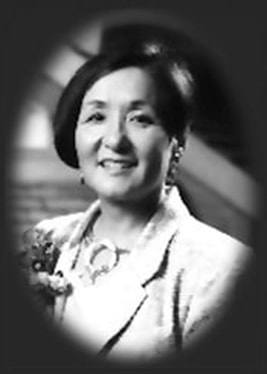
Her Story
Dorothy Kometani Kittaka’s education began in a nursery school inside Heart Mountain, an American concentration camp in Wyoming, where she was incarcerated at age two with her family and 120,000 other Japanese Americans during World War II. For three years, her parents, three older brothers, and she shared one room made over from old army barracks. Her earliest musical memory was the melancholy melody of a trumpet played by an elderly internee everyone called the “Poo-Pah-Poo Man” — a tune that has stayed with her for life. When her family was released in 1945, they settled in Marengo, Illinois, where a one-room-schoolhouse teacher and a piano teacher named Mrs. Coarson (who played and sang without looking at her hands) sparked a musical ambition so consuming that Kittaka pretended to play piano on windowsills and tables until her parents scraped together $35 for an upright piano when she was eight.
She majored in music education at Northern Illinois University, where a voice teacher, Howard Dill, redirected her from piano to voice and changed the course of her career — he even offered to tithe part of his salary toward her tuition, an offer she couldn’t accept but never forgot. After teaching choral and elementary music in Highland Park, Illinois and Naperville, Illinois, Kittaka came to Fort Wayne, Indiana in 1978, and by 1979 had settled into the elementary music specialist role at Haverhill Elementary School that she would hold for the next twenty years. She earned her Master of Science in Education from Indiana University at Fort Wayne (1979-82) on top of her 1961 bachelor’s degree in music education from Northern Illinois.
Kittaka’s honors accumulated steadily through the 1990s: Top Ten Finalist for Indiana State Teacher of the Year (1998); the “As They Grow Award” from Parents Magazine, presented at a White House ceremony with First Lady Hillary Clinton (1997); the Indiana Governor’s Arts Award, presented by Governor and First Lady O’Bannon (1997); Southwest Allen County Schools Teacher of the Year (1997); the Esther Ritz Collyer Award for Lifetime Achievement in Arts-in-Education (1997); Indiana Outstanding Elementary Music Teacher of the Year (1991); a First National Professional Best Award from Learning Magazine (1989); and selection for the Indiana Ambassadors in Education Teacher Exchange to Japan (1989). In 1984 she received the first John F. Kennedy Fellowship for Teachers in the Arts, a three-week residency at the Kennedy Center that treated her as a performing artist and culminated in a recital there, and she remained an active soprano soloist with the Fort Wayne Philharmonic Chorus for nearly two decades.
Beyond the Classroom
In 1987, Kittaka and colleague Michael Schmid co-founded the Foundation for Art and Music in Elementary Education (FAME) after writing one hundred letters of invitation to arts educators across Indiana. What began as a single Fort Wayne festival grew, over twelve years, into a two-day event held at four regional sites — Fort Wayne, Merrillville, South Bend, and Muncie — reaching an estimated 100,000 children and adults annually through its Visiting Artist Program, Culture Kits, teacher workshops, a student Composition Project performed by the Fort Wayne Philharmonic, and the Fusion of Concert Colors program pairing music and visual art. FAME won the Indiana Governor’s Arts Award and the “Good Neighbor Award” from State Farm and Parents magazine, and by her nomination its FAME Festival drew roughly 18,000 attendees and 17 hours of live NBC television coverage.
She served on the Indiana-Purdue Fort Wayne Community Advisory Council, the Arts United Arts in Education Committee (where she helped design the nationally cited Arts Leadership Initiative training program), the Fort Wayne Philharmonic Board (chairing its education committee for a year), the WBNI 89.1 fine arts radio board, and the Indiana Music Educators Association board, where she chaired the founding of “Circle the State with Song,” a children’s choir festival that grew to eleven sites statewide and established Indiana’s All-State Choirs for elementary and middle school. Her fifth-grade choir, the Haverhill Power Sound, performed regularly at nursing homes during the holidays, and she led her school’s annual all-fifth-grade Dinner-Theatre musical production, coordinating with classroom teachers, an art specialist, and parent volunteers on everything from choreography to set construction.
Philosophy Into Practice
Kittaka grounded her teaching in research on childhood music aptitude, citing Dr. Edwin Gordon’s finding that music aptitude is largely set by age nine — a “window” she believed made elementary music education urgent rather than optional. She rejected the idea of music as a scheduling “enrichment” period that merely freed up a classroom teacher’s prep time, insisting instead that music belonged in the curriculum on equal footing with the traditional three Rs, taught with historical context, aesthetic understanding, and active production through performance, improvisation, and composition.
In practice, this meant integrating music deeply into every grade’s core curriculum — a Mozart-centered opera unit for fifth graders studying “The Magic Flute,” complete with character analysis, costume design, and student-composed personal philosophies matched to music; culminating whole-school programs tied to social studies units on Australia, Africa, Fort Wayne, Indiana, and the Revolutionary War; and a belief, repeated throughout her essays, that a teacher must be a “people person” who sees potential in others, takes risks, and never stops being a student.
“Teaching is the most important profession in the world for it deals with developing minds of the leaders and followers of future generations… I feel that my most important job is to nurture young minds while this period of time is still open and I have a critical influence on how the child’s brain develops.”— from her essay, “Philosophy of Teaching”
“I believe a teacher is: one who is a ‘people’ person… one who is able to see the potential and possibilities in others… one who is willing to take risks… one who is in love with learning and has a burning desire to share this knowledge with others.”— from her essay, “Philosophy of Teaching”
In Her Own Words
“My education began in a nursery school in an American Concentration Camp in Heart Mountain, Wyoming. I was incarcerated in this internment camp during the hysteria of World War II at the age of two with my family and 120,000 other Japanese Americans living on the West Coast.”— from her essay, “Who Am I? What Makes Me Tick?”
“We called him the ‘Poo-Pah-Poo Man’ and his melody has lingered in my memory since that time. I still hear it in times of quiet and I thank him for his gift of music in those dark times.”— from her essay, “Who Am I? What Makes Me Tick?”
“I approach teaching with the idea that I am educating the whole child. I want my classroom to be a place in which a child can’t wait to come to class, because I show them with a smile that I want them there.”— from her essay, “In the Classroom”
“The fourth ‘R’ in education is in the ‘aRts’ and we must keep the arts in education for every child.”— from her essay, “In the Classroom”
“Music has enhanced my life beyond my wildest childhood dreams. It has taken me to foreign lands and even lunch at the White House; but the best part is to see what joy music brings to the children I am privileged to teach.”— from her essay, “Who Am I? What Makes Me Tick?”
What Others Said
t gives me great pleasure to nominate Dorothy Kittaka. Her whole life is an example of one who believes that the arts are a vital force in the education of children. Her enthusiasm for the importance of the arts ignites the spark of imagination, creativity and joy of learning in her students.”— Joyce Houser, Principal, Haverhill Elementary School (Nominator)
“Mrs. Kittaka’s excellence in teaching has been documented through her nomination for this prestigious recognition. Mrs. Kittaka is an inspiring teacher, a visionary leader and a committed worker who has no peer.”— Shelton E. Smith and David Skillman (also of the Peppers nomination), Lindbergh School District
“Dorothy Kittaka is an exceptional teacher who gives her bountiful energy, enthusiastic support, and tireless advocacy for arts for children… Dorothy Kittaka is an unpretentious person who is a cut above the rest. She has dedicated her life to children and music and is a model for us all.”— Toni Kring, Assistant Superintendent, Southwest Allen County Schools
“As a founder of the Foundation for Art and Music in Elementary Education (F.A.M.E.) and its current president, Dorothy has helped bring to life an organization which now stands, in my opinion, as the area’s most effective vehicle in delivering high-quality arts experiences to elementary school children.”— Geoff Gephart, President, Arts United of Greater Fort Wayne
“I have worked with Dorothy the past 14 years and collaborated with her on many projects… Dorothy was the Vice President of this organization the first 8 years and President the past 4 years. The organization has grown from a single festival in Fort Wayne, to include regional festivals in Muncie, Merrillville, and South Bend.”— Michael F. Schmid, Vice President, FAME, and FAME Co-Founder
“I must say that I will never forget Mrs. Kittaka. I have known her since Kindergarten and am now almost in middle school… I have learned the meaning of music and why it means so much to her. She has passed that love of music on to me and all the kids at Haverhill.”— Michael Niezer, Student